We helped 75+ brands generate $1.56M+ in revenue. Average ROI: 240% in Year 1
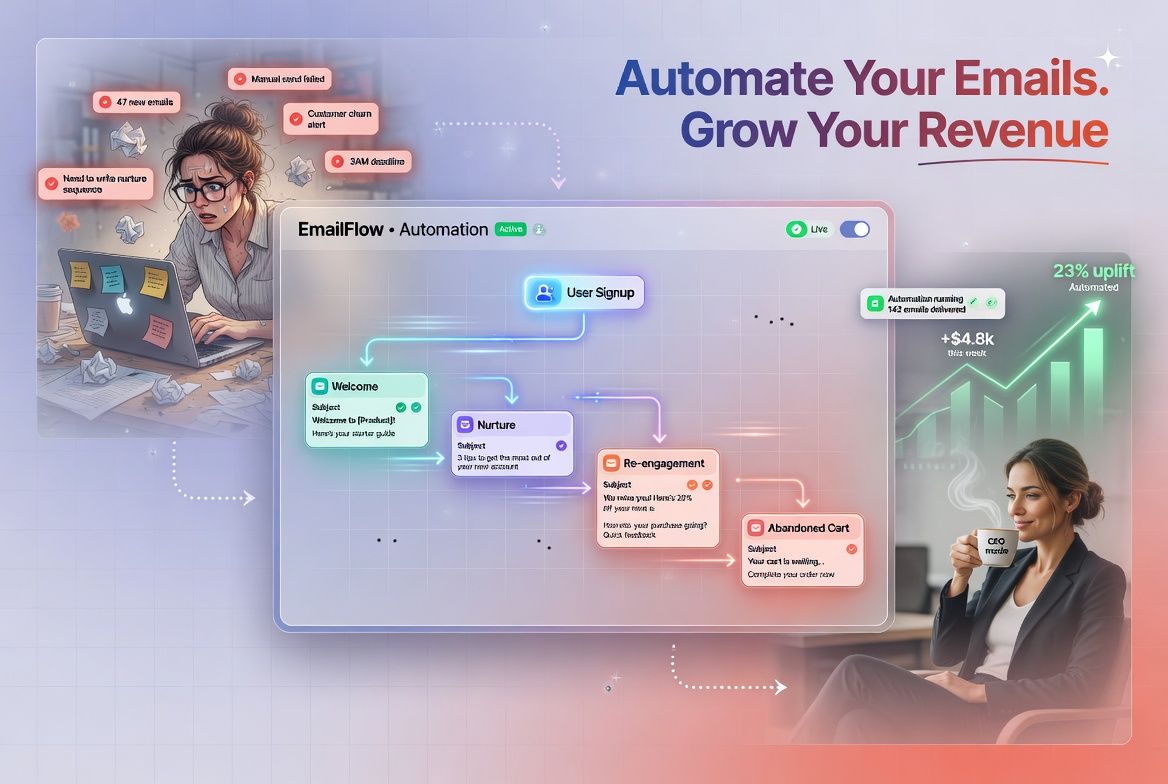
Email marketing automation is the difference between a marketing channel that requires constant manual effort and one that runs largely on its own — welcoming new subscribers, following up with prospects, re-engaging inactive customers, and generating revenue while you're focused on running your business.
Most small business owners have heard of automation but assume it's complicated, expensive, or only relevant to large companies with sophisticated marketing teams. None of those things are true. The most valuable automations for small businesses — the ones that generate the most revenue relative to setup time — are surprisingly simple. They require no coding, work with any modern email platform, and can be set up in a single afternoon.
This guide covers the 5 essential email sequences every small business should automate, a simple ROI calculator to evaluate the value of each, and how to decide whether to set them up yourself or work with a professional.
At AheadTech360, email automation setup is the single highest-ROI service we deliver to small business clients. The average time to build and activate the five sequences in this guide: 6–12 hours. The average monthly revenue generated once those sequences are running at full list volume: $800–$3,500 depending on business type and list size. Setup once. Runs forever.
Email automation is a system where emails are sent to subscribers automatically based on a trigger — an action, a time delay, or a specific condition — rather than requiring you to manually send each one.
The trigger might be: a new subscriber joining your list, someone visiting your pricing page, a customer who hasn't bought in 90 days, someone abandoning a shopping cart, or a specific date like a subscriber's anniversary. When the trigger fires, a pre-written email (or series of emails) is automatically delivered at the right time — without any manual action from you.
Manual email marketing requires you to choose who to email, when to email them, and what to say every single time you send. Automated email marketing makes those decisions once — when you build the sequence — and then executes them perfectly, at scale, indefinitely. The value of automation is not just time saved. It's the consistency and timeliness that would be impossible to achieve manually.
These five sequences represent the highest-value automations for most small businesses. Start with Sequence 1 (the Welcome Series) and add the others progressively over the following weeks.
Welcome Series
🔔 Trigger: New subscriber joins your email list
⏱ Timing: Email 1: Immediately on signup. Email 2: Day 2. Email 3: Day 5
📧 Number of Emails: 3 emails
🎯 Goal: Introduce your business, deliver your lead magnet, and convert a new subscriber into a paying customer or booked appointment within the first week
What each email does:
This is the most important automation for most small businesses — set it up first.
Nurture / Education Series
🔔 Trigger: Subscriber has been on your list 7+ days but hasn't converted
⏱ Timing: 4 emails over 14 days — every 3–4 days
📧 Number of Emails: 4 emails
🎯 Goal: Build trust through value delivery, position your business as the authority in your category, and move subscribers closer to booking or purchase
What each email does:
This is the most important automation for most small businesses — set it up first.
Re-engagement Series
🔔 Trigger: Subscriber hasn't opened an email in 60–90 days
⏱ Timing: 3 emails over 10 days
📧 Number of Emails: 3 emails
🎯 Goal: Reactivate dormant subscribers before they hurt your deliverability — or confirm they should be removed from your list
What each email does:
This is the most important automation for most small businesses — set it up first.
Post-Purchase / Thank You Series
🔔 Trigger: Customer completes a purchase or books a service
⏱ Timing: 3 emails over 14 days
📧 Number of Emails: 3 emails
🎯 Goal: Maximize customer satisfaction, generate reviews and referrals, and set up repeat purchases — the highest-ROI conversion is getting an existing customer to buy again
What each email does:
This is the most important automation for most small businesses — set it up first
Abandoned Cart / Booking Series
🔔 Trigger: Visitor starts checkout or booking process but doesn't complete it
⏱ Timing: 3 emails over 48 hours — timing is critical
📧 Number of Emails: 3 emails
🎯 Goal: Recover revenue from the highest-intent prospects on your list — people who were ready to buy but stopped for some reason
What each email does:
This is the most important automation for most small businesses — set it up first.
Every automation sequence requires upfront setup time but generates value indefinitely. Here's a realistic assessment of setup investment versus monthly revenue generated for a local service business with a 500-subscriber list and a $200 average service value:
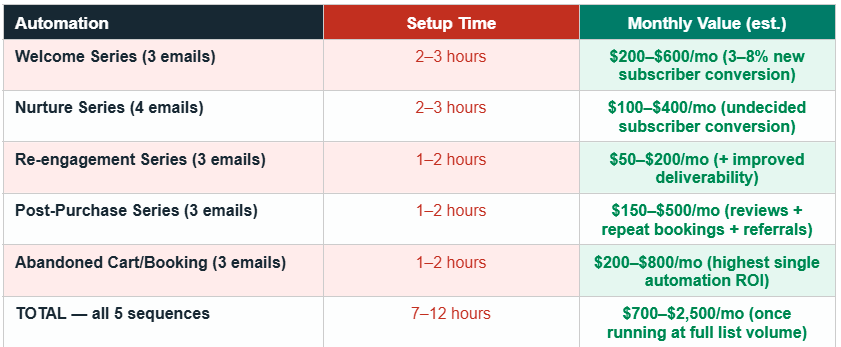
These numbers are conservative estimates for a list of 500 subscribers. As your list grows, the monthly value scales proportionally — a list of 2,000 subscribers running the same five sequences can reasonably generate $3,000–$10,000 per month in automated revenue, depending on service value and conversion rates.
The most common objection we hear to setting up email automation is 'I don't have time to set this up.' The irony is that the purpose of automation is to create time — each hour invested in setup generates dozens of hours of marketing work that would otherwise be done manually or not at all. A business owner who spends 10 hours setting up all five sequences in this guide frees up 2–5 hours per week of manual follow-up indefinitely. The break-even on setup time is typically less than 30 days.
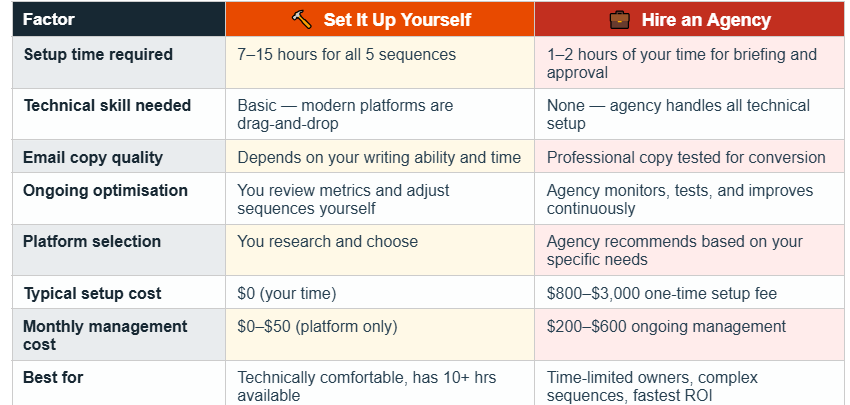
Both paths can work — the right choice depends on your technical comfort level, your available time, and how complex your automation needs are:
The most common automation mistake: building a complex 10-email sequence before testing a simple 3-email sequence. More emails is not better. Start with the Welcome Series only. Let it run for 4 weeks. Review your open rates, click rates, and conversion rate. Fix what's not working. Then add the next sequence. Building all five at once before any have been validated leads to complex, unoptimised systems that are harder to diagnose and fix.
Email marketing automation is not a luxury for businesses with large marketing teams. It is the most practical, highest-ROI investment a small business can make in its marketing infrastructure — because it converts the time you invest once into revenue that compounds indefinitely.
The five sequences in this guide — Welcome, Nurture, Re-engagement, Post-purchase, and Abandoned Cart — cover every stage of the customer relationship. Together, they create a complete system that acquires customers, keeps them engaged, generates reviews and referrals, and recovers lost revenue automatically.
You don't need a large team, a large budget, or technical expertise to build this. You need a good platform, clear writing, and the discipline to set it up properly rather than constantly starting from scratch. Build the foundation once. Let it work for you.
The best email you'll ever send is the one that sends itself.