We helped 75+ brands generate $1.56M+ in revenue. Average ROI: 240% in Year 1
And it almost always gets a frustrating non-answer: 'It depends.'
Yes — it depends. But on what, exactly? That's what this guide answers.
By the end you'll know the real CPM, CPC, and cost-per-lead benchmarks for your industry, what three different monthly budgets realistically deliver in leads and revenue, the minimum you need to spend to see actual results, and a simple formula to calculate the right budget for your specific business before you spend a dollar.
No vague ranges. No inflated promises. Real 2026 numbers from real campaigns — so you can make an informed decision about whether and how to invest in Meta Ads.
The first thing we do at AheadTech360 before recommending a Facebook Ads budget is run a market analysis — what are competitors spending in this industry and location, what is the average CPM and CPL for this audience, and what does our client's close rate look like. This guide gives you the same framework we use internally, applied to your own numbers.
How Facebook Ads Pricing Actually Works
Facebook Ads uses an auction-based pricing model — but unlike Google Ads, the primary pricing unit is not cost-per-click. It's CPM: cost per 1,000 impressions. You pay for your ad to be shown, and the platform optimizes to show it to the people most likely to take your desired action.
Your final cost per lead is determined by three things working together:
CPM (Cost Per 1,000 Impressions) — How much it costs for your ad to be shown 1,000 times. This is set by the auction — the more advertisers competing for the same audience, the higher the CPM. Industry, audience size, placement, time of year, and ad quality all influence CPM.
CTR (Click-Through Rate) — What percentage of people who see your ad actually click it. Average CTR on Facebook is 0.9–1.5% for most industries. Strong creative and a compelling offer can push this to 2–4%, dramatically reducing your cost per click.
Conversion Rate — Of the people who click your ad, how many take the action you want — filling out a lead form, booking an appointment, or making a purchase? This is determined by your landing page or lead form quality, not by Facebook itself.
The math: if your CPM is $10, your CTR is 1%, and your conversion rate is 20%, your cost per lead works out to $10 ÷ (1% × 20%) = $50 per lead. Improve any one of those three inputs and your cost per lead drops proportionally.
The biggest mistake small business owners make is judging Facebook Ads performance by CPM or CPC alone. A $15 CPM sounds expensive until you realize it's generating leads at $22 each with a 40% close rate. Always evaluate cost per lead and cost per acquired customer — not cost per click in isolation.
These are realistic averages for properly optimized US campaigns running in Meta Ads Manager — not boosted posts, and not first-week results before the algorithm has calibrated. Expect month-one numbers to run 20–40% higher as the algorithm learns your audience.
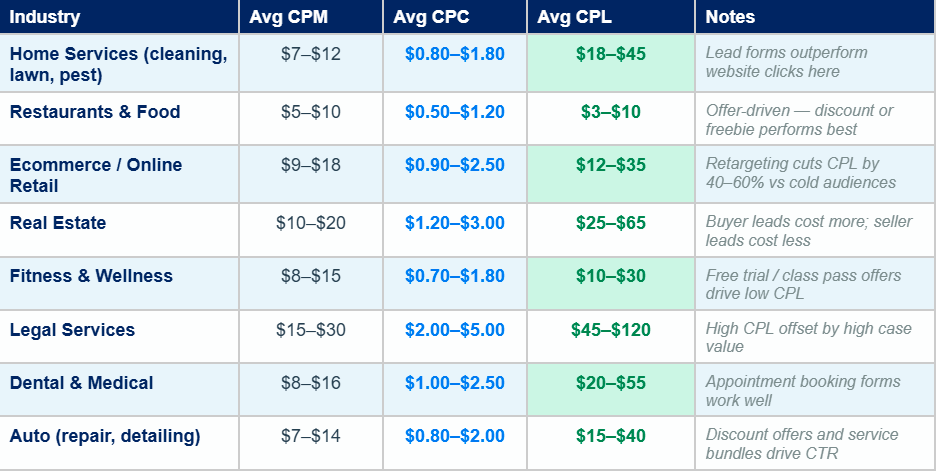
Important: these are industry averages across all US markets. Your actual numbers will vary based on your city's competition level, your audience size, your creative quality, and your offer strength. A highly competitive metro like NYC or LA typically runs 25–40% above these benchmarks. Smaller markets often run 15–25% below.
One pattern we see consistently across industries at AheadTech360: businesses that use Facebook's native Lead Gen forms (where users submit their information without leaving Facebook) typically see a 35–55% lower cost per lead compared to campaigns that send traffic to a website landing page. If you're not using lead forms, it's the single highest-impact change you can make to reduce your cost per lead immediately.
Here's what three different monthly budgets realistically deliver for a local service business in a mid-size US market — conservative estimates from optimized campaigns in month two or later:
Best for: testing the concept, very small service area, low-competition niche
What your budget gets you:
Enough budget for 1 active campaign, 1–2 ad sets, and 2–3 creative variations. Very limited data for optimization — the algorithm may not fully exit learning phase at this spend level. Best used to validate your offer and audience before scaling.
Realistic result (optimized, month 2+):
8–20 leads/month. 2–6 customers. Covers ad spend if average job value is above $150. Treat this as a proof-of-concept phase, not a growth engine.
Best for: most local service businesses — the minimum for consistent, reliable results
What your budget gets you:
2–3 active ad sets with enough daily budget ($15–$30/day per set) to exit learning phase within 2–3 weeks. Enough volume to run meaningful A/B tests on creative and audience. Algorithm has sufficient data to optimize delivery by month 2.
Realistic result (optimized, month 2+):
20–50 leads/month. 6–18 customers. Strong positive ROI for most service businesses with an average job value of $100+. This is where Meta Ads becomes a consistent, predictable lead channel.
Best for: competitive markets, multiple service areas, aggressive growth targets
What your budget gets you:
Full audience coverage — cold audiences, warm retargeting, and past customer re-engagement running simultaneously. Separate campaigns by service type. Lookalike audiences built from actual customer data. Continuous creative testing with 4–6 ad variations live at all times.
Realistic result (optimized, month 2+):
50–150+ leads/month. 15–50+ customers. Dominant market presence in most mid-size US cities. At this level, Meta Ads becomes your primary customer acquisition engine alongside or instead of paid search.
The minimum viable budget for most local service businesses on Facebook Ads is $400–$500/month in ad spend. Below this threshold, individual ad sets rarely get enough daily budget ($13–$16/day) to exit Meta's learning phase — a mandatory period where the algorithm needs 50 conversions per ad set to start optimizing efficiently. Without exiting learning phase, results are inconsistent and costs are inflated. Underspending is one of the most common and most expensive mistakes in Facebook advertising.
The better question before setting your Facebook Ads budget isn't 'how much does it cost?' It's 'what does a lead cost in my market, and what is that lead worth to my business?' Here's the framework:
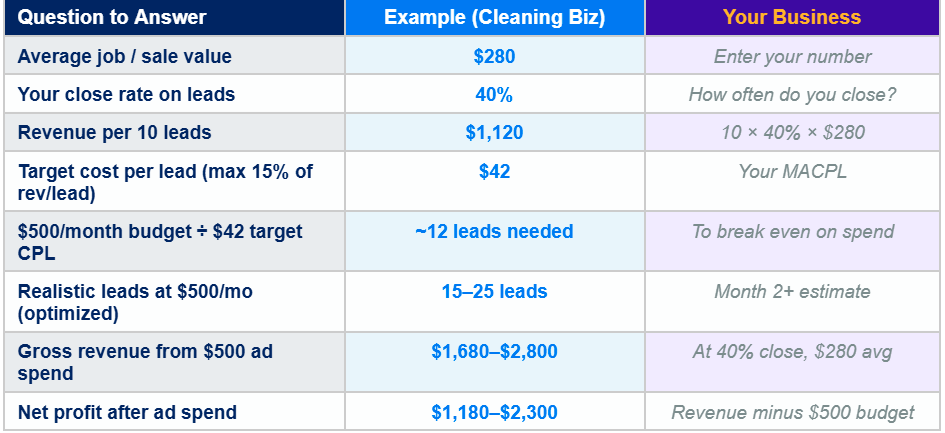
This home cleaning business only needs to close 2 jobs to cover a $500 monthly ad spend. Everything above that is profit. At 15–25 leads and a 40% close rate, they're generating 6–10 customers per month — meaning a $500 investment is producing $1,680–$2,800 in revenue. That's a 3.4–5.6x return on ad spend.
Calculate this before you set any budget: (Average Job Value × Close Rate) × 15% = MACPL. Example: $280 average job × 40% close rate = $112 revenue per lead. MACPL = $112 × 15% = $16.80. Wait — that seems low. Adjust: if your margin is higher (say 60%), use a higher percentage (20–25%). The point is to know your number before you spend — so you can judge performance objectively, not by gut feel.
At AheadTech360, we set a MACPL target for every Meta Ads client before the campaign launches — and we use it as the primary performance benchmark throughout the campaign. If we're generating leads below the MACPL, we scale budget. If we're above it, we optimize creative and targeting before spending more. This single number removes all the guesswork from Facebook Ads budget decisions.
Understanding why your costs look the way they do — and which levers you can pull to reduce them — is the difference between a frustrating first campaign and a profitable long-term channel.
1. Audience Size — Targeting a very narrow audience (under 50,000 people) drives up CPM because you're competing intensely for a small pool of impressions. Broadening your audience — while keeping it relevant — almost always reduces CPM. Meta's algorithm actually performs better with larger audiences because it has more data to find the right people within that pool.
2. Ad Creative Quality — Meta rewards engagement. Ads that generate high CTR, video views, and positive comments receive lower CPMs as a reward for relevance — similar to Google's Quality Score. Poor creative doesn't just underperform — it costs more per impression. Testing 3–4 creative variations from campaign launch is not optional — it's how you find the ad that earns a lower CPM through better engagement.
3. Time of Year — Q4 (October–December) is the most expensive period to advertise on Meta — CPMs can rise 30–60% as ecommerce brands flood the auction ahead of Black Friday and Christmas. If you're a non-ecommerce local business, consider reducing Meta spend in November–December and reallocating to Q1 when CPMs drop significantly.
4. Placement Selection — Facebook Feed, Instagram Feed, Reels, Stories, and Audience Network all have different CPMs. Reels placements currently offer the lowest CPM on the entire Meta platform — 20–40% below Facebook Feed for many industries. Using Advantage+ placements and letting Meta optimize the mix typically outperforms manual placement selection for most small business campaigns.
5. Offer Strength — The same audience, the same creative quality, and the same budget can produce wildly different cost-per-lead numbers depending on the offer. A $50 discount on a $300 service will consistently outperform a generic 'call us today' CTA. The most cost-efficient Meta campaigns have an irresistible, specific offer at their core — something that makes clicking and converting feel like an obvious decision.
Facebook Ads pricing is not fixed — it's determined by your industry, your audience, your creative quality, your offer, and the time of year. But the framework for evaluating it is always the same: know your maximum acceptable cost per lead, compare your actual CPL against that number, and scale when the math is working or optimize when it isn't.
The businesses that get predictable, profitable results from Facebook Ads are not the ones with the biggest budgets. They're the ones who understand their numbers — MACPL, close rate, average job value — and use those numbers to make rational decisions about budget, creative, and scaling.
Don't ask 'how much does Facebook Ads cost?' Ask 'what does a customer cost me through Facebook Ads, and what is that customer worth?' Answer that question and every budget decision becomes simple.