We helped 75+ brands generate $1.56M+ in revenue. Average ROI: 240% in Year 1
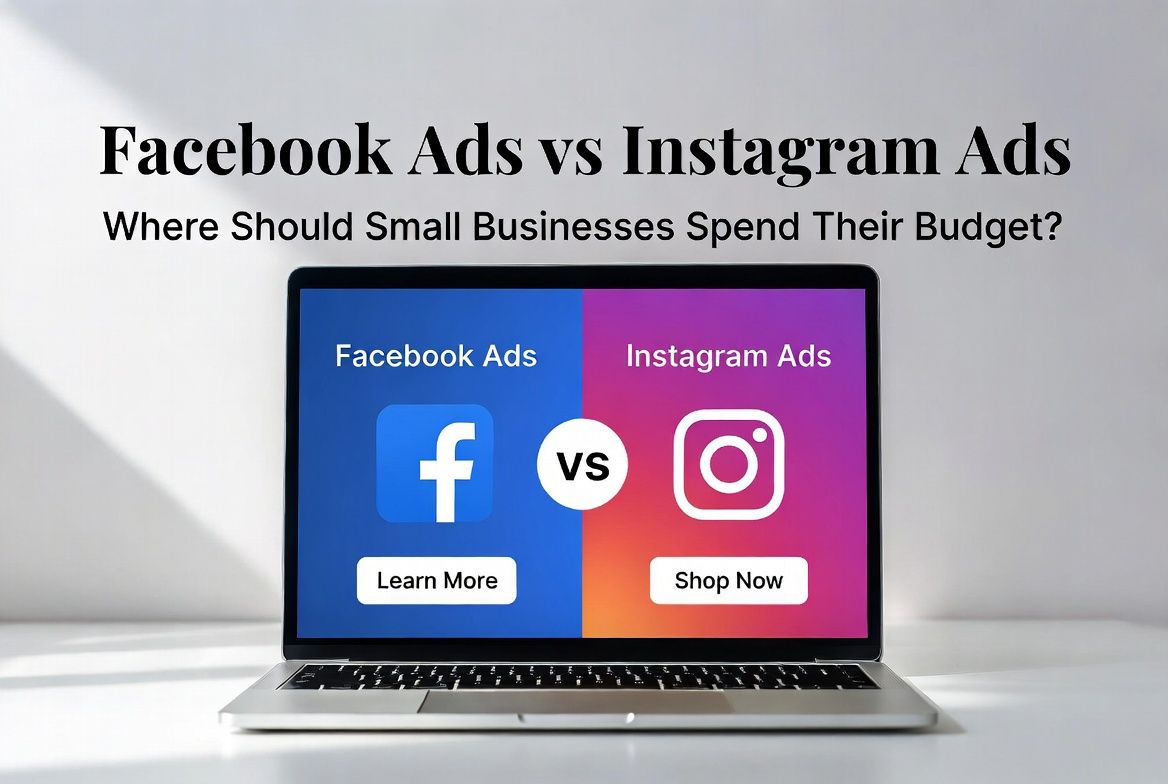
When most business owners decide to run Meta Ads, they face an immediate question: Facebook or Instagram?
It feels like it should be simple. But the answer matters more than most people realize — because the two platforms serve fundamentally different audiences, reward different types of creative, and perform very differently depending on what you're selling and who you're selling it to.
The good news is that both platforms run through the same Meta Ads Manager. You don't need a separate account, a separate budget, or a separate agency to use both. But knowing where to put your focus — and your money — requires understanding how the two platforms actually differ in practice.
This guide gives you a clear, practical breakdown of both platforms — audience data, ad formats, cost differences, and a direct industry-by-industry comparison — so you can make an informed decision before you spend a single dollar.
At AheadTech360, we almost never recommend running ads exclusively on one platform when a client's budget allows both. The most effective Meta campaigns we manage use Facebook for lead generation and retargeting while using Instagram for brand awareness and visual product showcasing — two complementary roles that together produce a lower blended cost per lead than either platform alone.
Facebook and Instagram are both owned by Meta and run through the same ad system — but they are used very differently by their audiences, and that changes everything about how advertising works on each one.
Facebook is where people go to connect with community, follow local groups, read news, watch longer videos, and engage with businesses they already know. The audience skews older, with the strongest engagement in the 35–65+ age range. Users are accustomed to reading longer captions, clicking links, and engaging with lead generation forms — making Facebook the stronger platform for direct response advertising.
Instagram is where people go to be inspired, discover new products, follow creators, and consume visual content. The audience skews younger, with the strongest engagement in the 18–34 range. Users are in a browsing, discovery mindset — which makes Instagram ideal for brand awareness, visual product showcasing, and impulse-driven purchases. But it requires strong visual creative to compete in a feed that is entirely image and video-driven.
The biggest mistake businesses make is choosing a platform based on personal preference rather than audience match. A roofing company owner who uses Facebook personally might assume their customers are on Facebook too — and they probably are. But a boutique clothing brand targeting 22-year-old women should be on Instagram regardless of whether the business owner uses it. The question is always: where does your customer spend their time online?
Here is a direct side-by-side breakdown of every dimension that matters for small business advertising decisions:
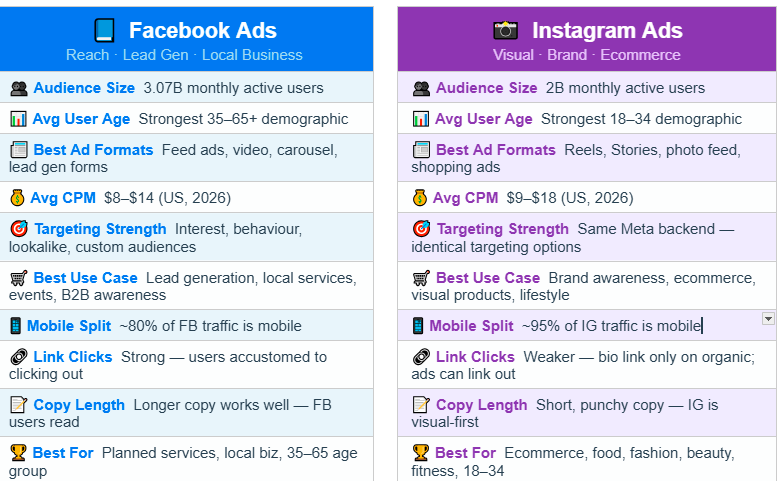
The most important takeaway from this comparison: targeting capabilities are identical on both platforms because they share the same Meta backend. The difference is entirely about where your creative is shown, who sees it, and how they interact with it.
Platform choice should follow your target customer's age and behaviour — not your personal preference or assumptions. Here is the demographic reality of both platforms in the US as of 2026:
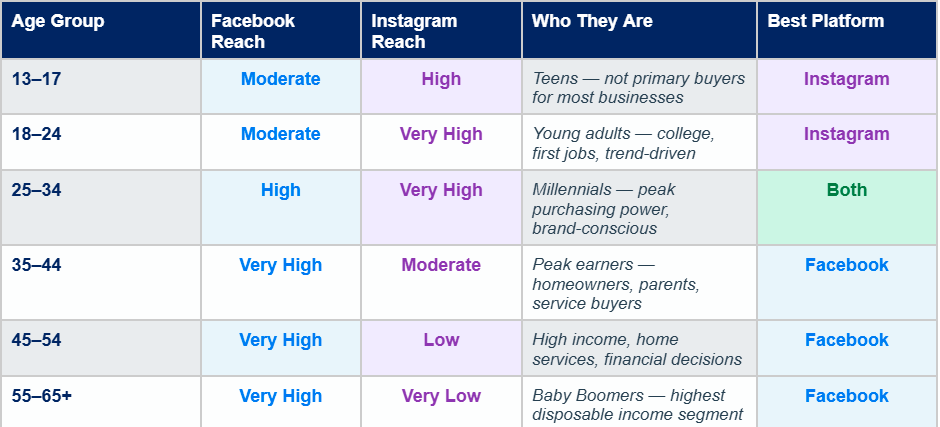
Practical implication: if your primary customer is a 35–65 year-old homeowner making a considered purchase decision — a home service, a legal consultation, a financial product, a major appliance — Facebook is your primary platform. If your customer is a 18–34 year-old making a visual, impulse-influenced, or lifestyle purchase — fashion, food, fitness, beauty, travel — Instagram is your primary platform.
Age alone does not determine platform fit — but it is the most reliable starting signal. At AheadTech360, when we set up a new Meta campaign for a client, the first question we ask is: 'Describe your best customer in 30 words or less.' If the answer includes words like 'homeowner,' 'professional,' 'parent of teenagers,' or 'business owner,' we lean Facebook. If the answer includes 'young professional,' 'fitness enthusiast,' 'fashion-forward,' or 'foodie,' we lean Instagram — or run both with different creative for each.
Lead Generation Forms — Facebook's native lead gen forms let users submit their name, email, and phone number without leaving Facebook. For local service businesses collecting appointment requests or quote inquiries, this is the single most effective Meta ad format available. Conversion rates are typically 3–5x higher than sending traffic to a website.
Video Ads (Feed) — Facebook users watch significantly more long-form video than Instagram users. A 60–90 second explainer video showing a before-and-after transformation, a customer testimonial, or a behind-the-scenes process can build enormous trust — especially for service businesses where credibility matters.
Carousel Ads — Multiple image or video cards in a single ad unit. Ideal for showing multiple services, multiple product variants, or telling a sequential story. Strong click-through rates on Facebook because users are comfortable swiping through content.
Event Ads — Facebook's event infrastructure makes it the dominant platform for promoting local events, workshops, sales, and grand openings. Instagram has no equivalent native event feature.
Reels Ads — Instagram Reels ads are currently the highest-reach, lowest-CPM format on the entire Meta platform. Short-form vertical video (15–30 seconds) that blends seamlessly into the Reels feed. If you can produce engaging short video content, Reels ads offer exceptional reach per dollar in 2026.
Stories Ads — Full-screen vertical ads between user Stories. High visibility, immersive format. Best for time-sensitive offers, dramatic before/after reveals, and lifestyle visual content. 24-hour urgency framing works well here.
Shopping / Catalogue Ads — Instagram's native shopping integration makes it the clear choice for ecommerce businesses. Product catalogue ads let users browse and purchase directly within Instagram, dramatically reducing friction in the purchase path.
Explore Ads — Ads that appear in the Instagram Explore feed — where users are actively discovering new accounts and content. High reach potential for brand awareness campaigns targeting new audiences.
💡 AheadTech360 Insight
One tactical insight we apply at AheadTech360: even for clients whose primary platform is Facebook, we always test Instagram Reels placements at a small budget allocation. Reels consistently deliver the lowest CPM of any Meta placement — meaning we can generate brand awareness touchpoints for the same audience at a fraction of the cost of Facebook feed placements. We use Facebook for conversions and Instagram Reels for reach.
This is the most practical question for most business owners. Based on typical audience demographics, purchase behaviour, and creative format fit, here is how the two platforms compare across common small business industries
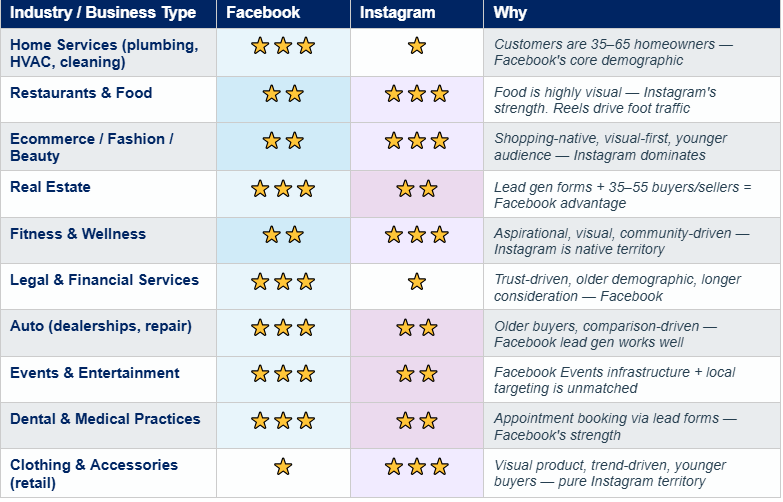
Legend: ⭐⭐⭐ = Primary platform • ⭐⭐ = Strong secondary • ⭐ = Possible but not optimal
If your budget is $600/month or more, run both platforms with the same campaign — Meta's automatic placements will distribute your budget to whichever platform is delivering better results for your objective. Let the algorithm decide the split based on real performance data rather than assumptions. If your budget is under $400/month, focus exclusively on Facebook for lead generation until you can afford to test Instagram as a secondary channel.
Facebook and Instagram Ads are not competing choices — they are complementary tools serving different audiences and different moments in the customer journey. For most small businesses, the right answer is not 'Facebook or Instagram' but 'Facebook for this objective, Instagram for that one.'
If you sell a visual, lifestyle, or impulse product to customers under 35 — Instagram should be your primary platform. If you sell a considered service to homeowners, professionals, or anyone over 35 — Facebook should be your primary platform. And if your budget allows both, running them together with the right creative for each typically delivers a lower blended cost per lead than either platform alone.
The platforms share the same targeting engine. The difference is in the audience, the creative format, and the mindset of the person scrolling. Match your message to the moment — and the results follow.