We helped 75+ brands generate $1.56M+ in revenue. Average ROI: 240% in Year 1
Here is something that surprises most small business owners when they first hear it: on Google Ads, the business spending more money does not always win.
A local HVAC company with a $600/month budget can outrank a national HVAC brand spending $6,000/month — appearing higher in search results, paying less per click, and generating more leads per dollar. Not because of some loophole or trick. Because of Quality Score.
Quality Score is Google's rating of how relevant and useful your ad is to the person searching. It is measured on a scale of 1 to 10. And it directly determines two things that matter enormously to your campaign: where your ad appears on the page, and how much you pay per click.
Most small business owners running Google Ads have never looked at their Quality Scores.
Those who understand and improve them consistently pay 30–50% less per click than their competitors — and rank higher at the same time. This guide explains exactly how that works and what you can do about it.
At AheadTech360, Quality Score optimization is one of the first things we focus on when we take over a new Google Ads account. In most accounts we inherit, we find 30–50% of keywords running at a Quality Score of 4 or below — meaning the client is paying significantly more per click than they need to. Fixing this alone often reduces cost per lead by 25–40% within the first 60 days.
Quality Score is a diagnostic metric Google assigns to each keyword in your account on a scale of 1 to 10. A score of 1 means your ad is poorly matched to what people are searching for. A score of 10 means your ad is highly relevant, your click-through rate is strong, and your landing page delivers exactly what the ad promised.
Google uses Quality Score because its business model depends on showing people ads they actually want to click. An irrelevant ad that nobody clicks damages Google's user experience and generates no revenue. So Google incentivizes relevance: advertisers with higher Quality Scores pay less and rank higher. Advertisers with low Quality Scores pay a premium — essentially a tax on irrelevance.
Higher Ad Rank = Higher Position on Page + Lower Cost Per Click
This means a small business with QS 9 and a $4 bid can outrank a big brand with QS 4 and an $8 bid.
The formula means a small business with a Quality Score of 8 and a $4 maximum bid has an Ad Rank of 32. A national competitor with a Quality Score of 4 and an $8 maximum bid also has an Ad Rank of 32. They tie — but the small business pays half as much per click. With a Quality Score of 9 or 10, the small business wins outright, appearing above the big brand and still paying less.
Competitor max bid: $8. Quality Score: 4/10. Their actual CPC: approximately $6.25. Your max bid: $4. Quality Score: 8/10. Your actual CPC: approximately $3.75. You rank higher, pay less, and generate more leads per dollar — simply because your ad and landing page are more relevant to the person searching. This is not theory. This is how Google's auction works every single time.
Quality Score is made up of three equally weighted components. Understanding each one is essential because each requires a different fix when the score is low.
How likely is someone to click your ad when they see it?
Expected CTR is Google's prediction of how often your ad will be clicked when it is shown for a particular keyword. Google calculates this based on your historical CTR for that keyword, adjusted for factors like ad position.
A high expected CTR tells Google your ad is compelling and relevant. A low expected CTR tells Google people are seeing your ad and choosing to ignore it — which is a strong signal that something about your headline or offer doesn't match what the searcher wants.
What drags CTR down:
What improves CTR:
How closely does your ad match the intent behind the search query?
Ad relevance measures how closely your ad copy aligns with the keyword that triggered it. Google is asking: if someone searches for 'roof repair Austin,' does your ad actually talk about roof repair in Austin — or does it talk about your general roofing company?
Low ad relevance is almost always caused by poor campaign structure — specifically, ad groups that contain too many different keywords, making it impossible to write ad copy that is relevant to all of them simultaneously.
The common mistake:
One ad group containing: 'plumber Dallas,' 'drain cleaning Dallas,' 'water heater repair Dallas,' 'leak repair Dallas,' 'toilet installation Dallas' — all served by the same generic ad. The ad cannot be highly relevant to all five of those different intents at once.
The fix:
Tightly themed ad groups — each containing only 3–5 closely related keywords, with ad copy written specifically for that theme. 'Drain Cleaning Dallas' gets its own ad group with ads that talk specifically about drain cleaning. 'Water Heater Repair Dallas' gets its own ad group with ads about water heaters. Each group, each ad, each landing page — all aligned to one specific intent.
Does your landing page deliver what your ad promised?
Landing page experience is Google's assessment of how useful and relevant your landing page is to the person who just clicked your ad. Google evaluates page load speed, mobile-friendliness, relevance of the page content to the ad, and how easy it is for visitors to find what they came for.
This is where most small business campaigns lose Quality Score points quietly. The ad is relevant. The CTR is decent. But the landing page is either the generic homepage (which covers everything and is highly relevant to nothing) or it loads slowly on mobile, or it doesn't clearly deliver what the ad specifically promised.
The four things Google's algorithm checks:
This table shows exactly how Quality Score adjusts your actual CPC relative to a competitor's maximum bid. These adjustments are not estimates — they reflect Google's documented bid adjustment formula.
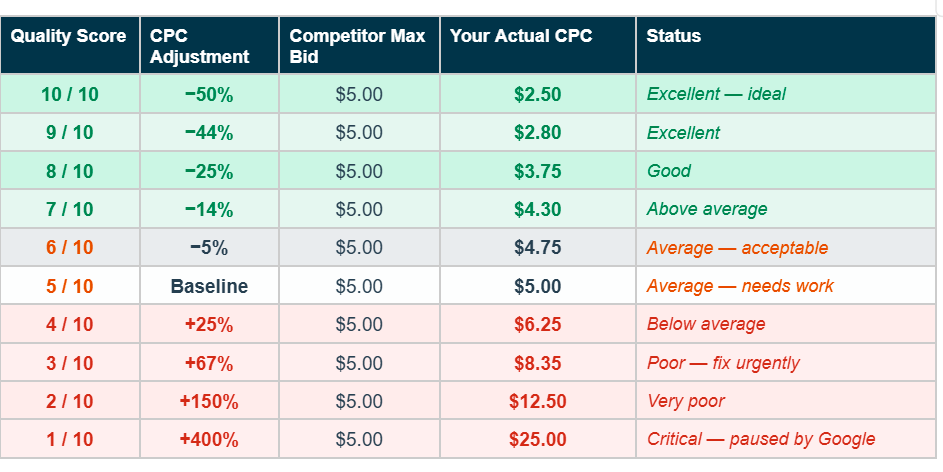
Read that table carefully. A business with a Quality Score of 3 is paying $8.35 per click while their competitor with a Quality Score of 8 pays $3.75 for the same keyword — and ranks higher. The low-score business is spending more than twice as much per click and getting worse placement. This is the compounding cost of ignoring Quality Score.
When we audit a new Google Ads account at AheadTech360, the Quality Score table is the first report we pull. In competitive markets like HVAC, plumbing, and legal services, the difference between a QS 4 and a QS 8 campaign often translates to $15–$25 per click in savings. On a $1,000/month budget with 200 clicks, that's $3,000–$5,000 in annual savings — simply from optimizing relevance.
Large brands typically run national campaigns with broad, generic keywords and one-size-fits-all ad copy. They're not writing ads specifically for someone searching 'emergency plumber North Dallas' — they're writing ads that work adequately for everyone across the country.
A local small business has a structural relevance advantage: every keyword, every ad, and every landing page can be written specifically for the exact local intent of their specific customer. That local specificity is extremely difficult for a national brand to replicate at scale — and Google rewards it with higher Quality Scores.
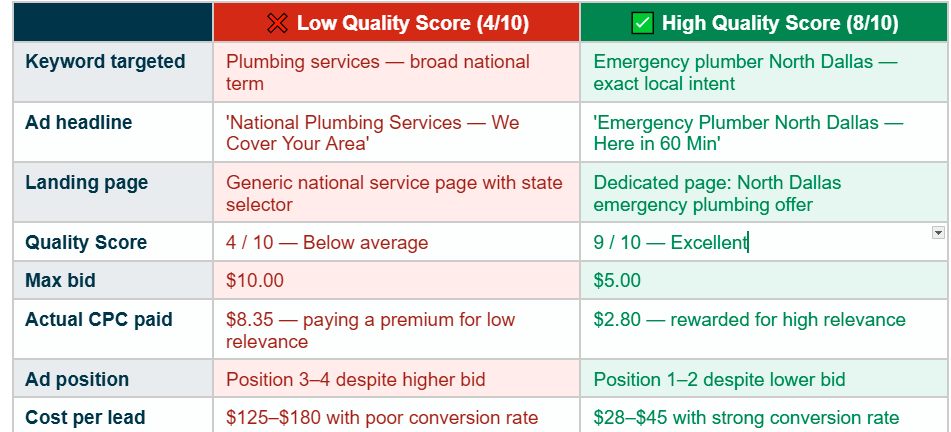
This is not a hypothetical. This is the consistent pattern we see when properly structured small business campaigns go head-to-head with national brands on local keywords. Specificity wins every time.
Most Quality Score improvements compound over 2–4 weeks as Google updates its assessments based on new performance data. But the actions that drive those improvements can be taken today:
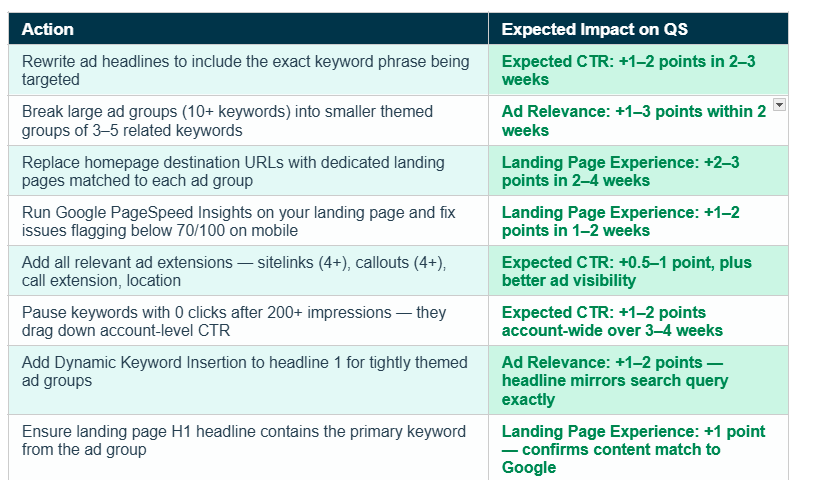
Quality Score improvements are not instant. Google recalculates scores over time as new data accumulates. Don't make changes and expect the score to jump overnight — give changes 2–4 weeks before evaluating impact. The compounding effect over 90 days is where the real savings appear.
Quality Score is the most underutilized lever in Google Ads — especially for small businesses. Most business owners focus entirely on budget and bids, treating Google Ads like an auction where the biggest wallet wins. Quality Score proves that is not how the platform works.
Google's auction rewards relevance. A small business with tightly structured ad groups, compelling headlines that mirror the searcher's exact intent, and a fast-loading landing page that delivers precisely what the ad promised will consistently pay less per click and rank higher than a large brand throwing budget at generic keywords.
You cannot buy your way to a high Quality Score.
You earn it through relevance. And the businesses that earn it get to pay less for every lead while their less-relevant competitors pay more for worse results. That is the compounding advantage of understanding Quality Score.
Relevance is free. Irrelevance is expensive. Quality Score is how Google keeps score.