We helped 75+ brands generate $1.56M+ in revenue. Average ROI: 240% in Year 1
This is one of the most common questions we hear from small business owners who are ready to invest in paid advertising.
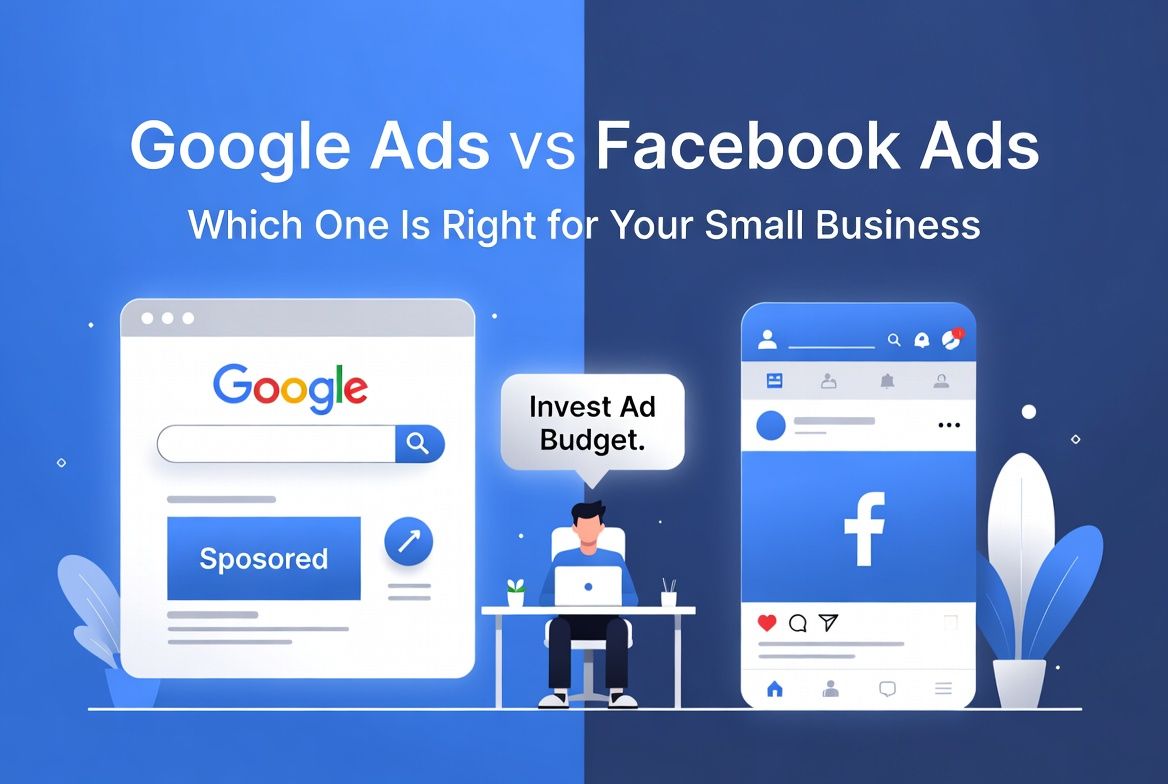
And it makes total sense to ask — because Google Ads and Facebook Ads are very different platforms that do very different things. Choosing the wrong one for your business type is one of the fastest ways to waste your ad budget.
In this guide, we'll break down exactly how each platform works, which businesses each is best suited for, and — most importantly — which one you should start with based on what you're actually selling.
No bias toward either platform. Just the honest breakdown you need to make a smart decision.
At AheadTech360, we manage both Google Ads and Meta Ads campaigns for small businesses across the US. The number one mistake we see? Business owners picking a platform based on what their friend uses — not based on what matches their business model. This guide fixes that.
When someone types a search query into Google, they're expressing clear intent. They're looking for something specific, right now. Google Ads puts your business in front of that person at that exact moment.
You show up when people are actively searching for what you sell.
Google Ads works best for:
Local service businesses — plumbers, electricians, HVAC, roofers, landscapers, cleaners, dentists, lawyers
High-value, low-frequency purchases — wedding photographers, contractors, movers, accountants
Emergency or time-sensitive services — towing, locksmith, water damage restoration
Any business where customers actively search before buying — most B2B services, medical practices, financial services
Meta Ads work completely differently. Nobody goes to Facebook or Instagram to search for a plumber. They're there to scroll, connect, and be entertained.
Meta Ads interrupt that scroll with a visually compelling message — and when done right, they create awareness and desire for things people didn't know they wanted until they saw your ad.
You reach the right people before they start searching — and make them want what you offer.
Ecommerce businesses — clothing, accessories, home goods, beauty products, specialty food
Restaurants, cafes, and food businesses — Instagram in particular is powerful for food content
Event-based businesses — gyms, yoga studios, workshops, local events
Online courses, coaching, and subscriptions — audience building and awareness campaigns
Any business with a visually compelling product or offer — if it looks good, Instagram sells it
One thing we've learned managing Meta campaigns at AheadTech360: the ad creative makes or breaks the campaign. A great offer with a weak image or video will underperform every time. We spend as much time on the creative as we do on the targeting — because on Meta, the creative IS the targeting.
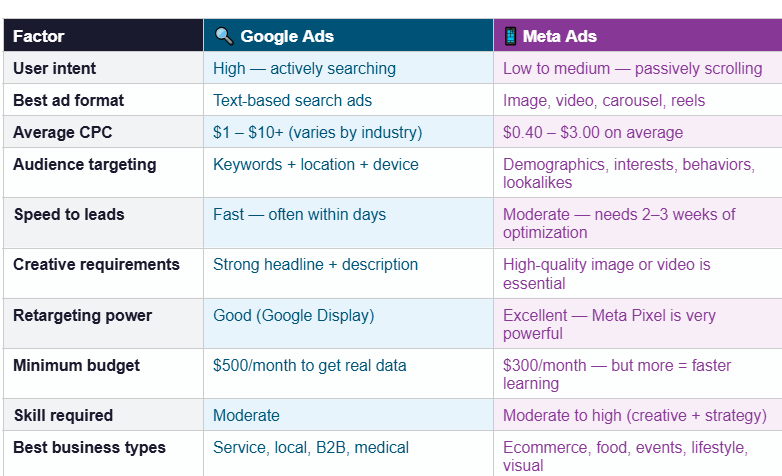
Use this table as your starting point. Every business is different, but these are the patterns that hold true for the vast majority of small businesses:
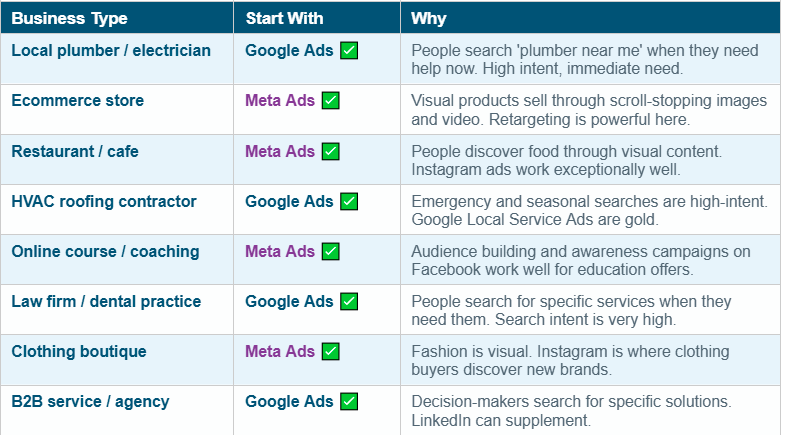
Yes — and for many businesses, running both together is the most powerful strategy. But only once you've found profitability on one platform first.
Here's the smart approach:
Step 1 — Start with the platform that matches your business type (use the table above). Master it, optimize it, find your profitable campaigns.
Step 2 — Once your first platform is consistently generating positive ROI, add the second platform for a different objective. Use Meta Ads for retargeting website visitors from your Google Ads campaigns — this combination is extremely effective.
Step 3 — As both channels scale, you'll build a full-funnel paid strategy: Google Ads captures people who are searching, Meta Ads reaches people who visited but didn't convert, and nurtures cold audiences into future buyers.
Some of our best-performing AheadTech360 client campaigns use exactly this combination: Google Ads for direct lead capture, Meta retargeting ads to follow up with website visitors who didn't convert. The two platforms amplify each other. The results are consistently stronger than either platform alone.
Choosing based on what they personally use. Just because you're on Facebook all day doesn't mean your customers are searching for your services there. Match the platform to your customer's behavior, not yours.
Starting on Meta Ads because it 'feels cheaper.' Lower CPCs don't mean lower cost per acquisition. If conversion rates are lower (which they often are for service businesses on Meta), the actual cost per customer can be higher.
Expecting Meta Ads to work like Google Ads. They require different creative, different targeting logic, and different performance benchmarks. Applying Google Ads thinking to Meta campaigns is a common and expensive mistake.
Running both platforms simultaneously with a small budget. Splitting $500/month across two platforms means $250 each — not enough to get meaningful data from either. Go deep on one first.
Google Ads and Facebook Ads are not competitors — they're different tools built for different jobs.
If people are actively searching for what you sell, start with Google Ads. You're putting your business in front of buyers who are already looking for you. That's as close to a guaranteed sale as advertising gets.
If your product needs to be seen to be desired — if you need to create awareness and reach people before they start searching — Meta Ads is your platform. Visual products, lifestyle brands, and ecommerce businesses consistently see strong results here.
The best-performing small businesses in 2026 are using both platforms together — but they started with one, mastered it, and scaled before adding the second. That's the strategy that works.
The right platform isn't the one everyone else is using. It's the one your customers are on.