We helped 75+ brands generate $1.56M+ in revenue. Average ROI: 240% in Year 1
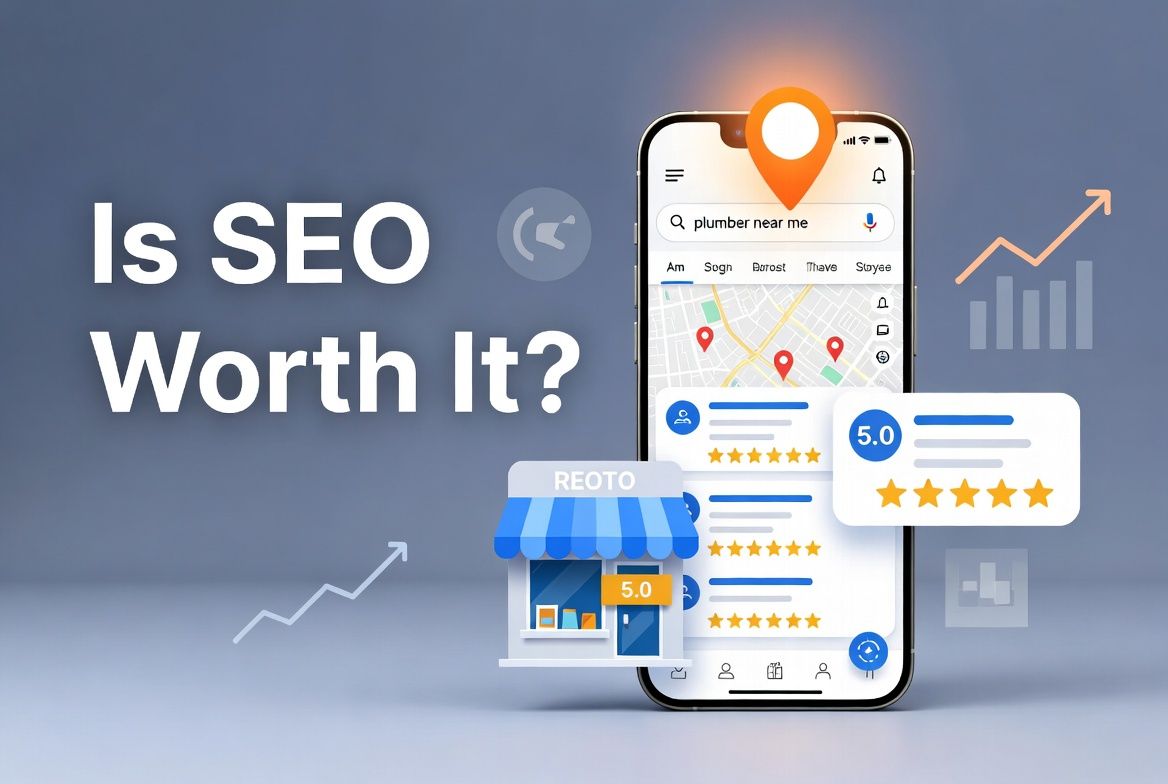
Is SEO Worth It for Small Businesses in 2026?
You built your business the hard way.
Early mornings. Late nights. Word-of-mouth referrals. Showing up when others didn't.
And it worked — for a while.
But now you're noticing something. Customers aren't just asking neighbors for recommendations anymore. They're grabbing their phones and typing things like:
"best plumber near me"
"electrician in [my city]"
"affordable contractor for home renovation"
And when they do — your business isn't showing up.
Someone else is. Someone who might not even be as good as you.
That's the reality of running a small business in 2026. And that's exactly why you're asking:
Is SEO actually worth it?
Let's give you a straight, honest answer.
SEO stands for Search Engine Optimization. But forget the technical definition for a second.
Here's what it actually means for your business:
SEO is the reason why one business shows up on Google when a customer searches for a service — and another business doesn't.
That's it.
When someone in your city searches "water heater repair" at 9pm on a Tuesday — SEO decides whether they find you or your competitor.
It's not magic. It's not luck. It's a system. And when that system is built right, it works for you 24 hours a day, 7 days a week — even when you're on the job, even when you're asleep.
Short answer: Yes.
Longer answer: Yes — but only when it's done right and given enough time to work.
Here's what the data says:
68% of all online experiences begin with a search engine.
46% of all Google searches are looking for local information. That means nearly half of everyone searching is looking for a business near them.
76% of people who search for a local business on their phone visit that business within 24 hours.
These aren't big corporations getting this traffic. This is the electrician down the street. The HVAC company in the next town over. The local contractor who started showing up on Google six months ago.
The question isn't whether SEO works for small businesses. It does. The question is whether you're going to be the business that shows up — or the one that gets skipped.
This is where most businesses get burned.
They invest in SEO, expect the phone to ring in two weeks, nothing happens, and they call it a scam.
Here's the real timeline — no sugarcoating:
This is the invisible phase. Your website is being fixed, content is being created, technical issues are being resolved. You won't see big results yet. But the work happening here is everything. Think of it like laying a foundation before building a house.
Google starts noticing you. Your website begins appearing for some search terms. You might get your first organic call or inquiry. Rankings start to move.
This is where SEO gets exciting. Rankings improve. Traffic grows. Leads come in consistently. And here's the best part — unlike paid ads, this traffic doesn't stop the moment you stop paying. It keeps building.
The businesses that quit at month two never find out what month eight looks like.
Let's make this real.
Say you're a contractor in Austin, Texas. You specialize in kitchen renovations.
Without SEO, when someone searches "kitchen renovation contractor Austin" — your competitor shows up. They get the call. They book the job. You have no idea it even happened.
With SEO, here's what changes:
You show up on Google Maps. When someone searches locally, they see a map with three businesses. Your name, reviews, photos, and phone number are right there.
Your website appears in search results. Someone searching "how much does a kitchen renovation cost in Austin" finds your blog post. You've already answered their question before they even call you. Trust is built before the first conversation.
AI tools recommend you. In 2026, people don't just search Google. They ask ChatGPT. They ask Google's AI. They ask Siri. Good SEO today means showing up in those answers too.
You stop chasing leads — they start finding you.
This is one of the most common things we hear from small business owners. And almost every time, it wasn't the SEO that failed. It was one of these things:
The wrong keywords were targeted. Going after "contractor" or "plumber" alone is nearly impossible. These are dominated by national directories and big brands. Going after "licensed contractor in Austin" or "emergency plumber in Dallas" — that's where a small business can actually win.
The content was written for Google, not people. Stuffing keywords into boring paragraphs doesn't work anymore. Google in 2026 rewards content that actually helps the reader — not content that's just trying to rank.
Results were expected too quickly. If someone promised you SEO results in 30 days, they were not being honest with you. Meaningful traction takes 3–6 months. Real, lasting results take 6–12 months.
Nothing was consistent. One blog post doesn't move the needle. SEO is a long-term commitment — regular content, ongoing optimization, and consistent effort over time.
Let's flip the question for a second.
What is it costing you to NOT be on Google?
Every single month you're not showing up in search results, someone else is getting those calls. Those jobs. That revenue. And you don't even know what you're missing.
Let's put a number on it.
Say SEO brings in just 4 extra jobs a month. Your average job is worth $600. That's $2,400 in new revenue every month. $28,800 a year — from customers who were already searching for you. You just weren't showing up.
Meanwhile — paid ads stop the moment you stop paying. Social media posts disappear in 24 hours. SEO keeps compounding. A blog post you publish today can still bring in leads two years from now.
More than ever. Here's why.
People don't just type into Google anymore.
They ask ChatGPT "who's a good electrician near me." They ask Google's AI Overview for a quick answer.
They ask Siri while driving. They use voice search on their smart speakers at home.
Good SEO in 2026 means showing up across all of these touchpoints. This new type of visibility includes:
AIO (AI Overview Optimization) — Getting your content featured in Google's AI-generated answers at the top of the page.
GEO (Generative Engine Optimization) — Getting your business recommended by AI tools like ChatGPT and Gemini.
AEO (Answer Engine Optimization) — Writing content that directly answers questions people ask search engines.
Most small businesses have no idea these exist. Which means right now, the window to get ahead of your competition is wide open. But it won't stay open forever.
If you're a small business owner reading this, here's what actually moves the needle — in order of priority:
1. Get your Google Business Profile right. Name, category, services, photos, and responses to every review. This is free and directly impacts whether you show up on Google Maps.
2. Make sure your website works on mobile. Over 70% of local searches happen on phones. If your website looks broken on mobile, you're losing customers before they read a single word.
3. Create content that answers real questions. What does a water heater replacement cost? How do I know if I need a panel upgrade? Answer these honestly on your website and you build trust before the first call.
4. Be consistent — and patient. The businesses winning on Google right now are the ones that stayed consistent when results were slow. That consistency is exactly what their competitors gave up on.
5. Work with people who understand your goals. Find an agency that talks about leads and revenue — not just rankings and traffic numbers.
SEO is worth it for small businesses in 2026.
Not as a quick fix. Not as a magic button. But as a long-term investment in your business's ability to be found by the customers who are already looking for you.
The businesses winning on Google today didn't get there overnight. They made a decision, stayed consistent, and let the results compound.
The best time to start was a year ago. The second best time is right now.