We helped 75+ brands generate $1.56M+ in revenue. Average ROI: 240% in Year 1
If you've been researching paid advertising for your local business, you've probably encountered both Google Local Service Ads and standard Google Ads. They both show up on Google. They both cost money. And at first glance, they look like they do the same thing.
They don't.
These are two fundamentally different products with different pricing models, different eligibility requirements, different levels of control — and very different strengths. Choosing the wrong one (or ignoring one entirely) can mean spending more per lead than you need to, or missing out on the most visible position on the entire search results page.
This guide breaks down exactly what each product does, what it costs, who it's right for, and why the smartest strategy for most eligible local businesses is to run both simultaneously.
At AheadTech360, when a client is eligible for LSA, we almost always recommend running it alongside their Google Search Ads campaign — not instead of it. The two products occupy different positions on the search results page, target different stages of buyer intent, and complement each other in ways that dramatically improve total lead volume without doubling total cost.
Before comparing costs and targeting, you need to understand the physical layout of a Google search results page for a local service query — because position matters enormously.
The green "Google Screened" badge, business name, star rating, phone number, and service area. Appears ABOVE everything else — above regular ads, above maps, above organic results. Only businesses that have passed Google's verification get this placement.
The text ads with headlines and descriptions you write yourself. These appear below LSA results but above the organic (non-paid) search results. Up to 4 paid search ads can show here. This is traditional Google Ads territory.
Unpaid results ranked by Google based on content quality, authority, and relevance. These appear below both LSA and Search Ads. Ranking here takes months of SEO work — but costs nothing per click.
Key insight: Running both LSA and Google Search Ads gives you the top two paid positions on the page — a dominant presence that is very difficult and expensive for competitors to match.
For a high-intent local search like 'HVAC repair near me,' a business running both LSA and Google Search Ads can occupy the top two paid ad positions simultaneously. A competitor running only Google Search Ads is immediately beneath them. A competitor running only SEO is below all paid results. That top-of-page dominance is the strategic argument for running both products.
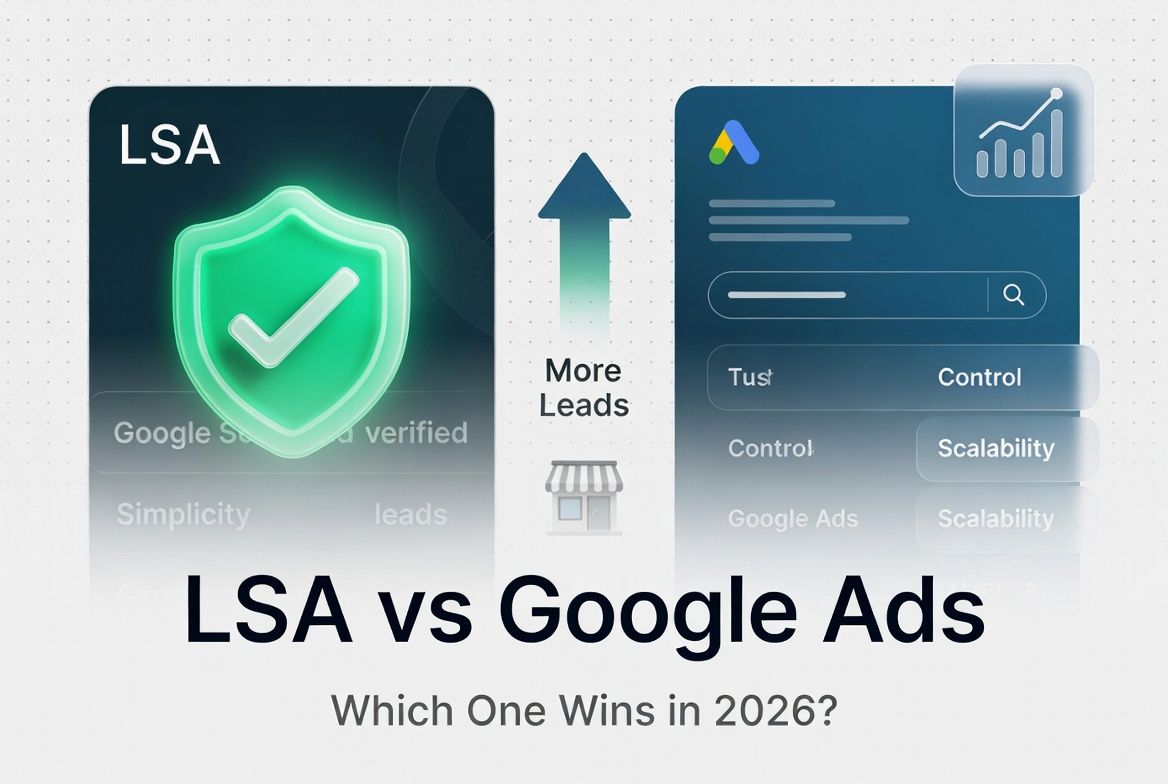
Google Local Service Ads — also called LSA or Google Screened ads — are a separate paid advertising product designed specifically for local service businesses. Unlike standard Google Ads where you pay per click, LSA charges you only when a potential customer contacts your business directly through the ad — either by calling or sending a message.
This pay-per-lead model is the defining feature of LSA. You don't pay for someone clicking your ad out of curiosity. You pay only when they pick up the phone or send an inquiry.
Who Qualifies for LSA?
LSA is not available to all businesses. Google restricts it to specific service categories and requires verification. The main eligible categories include:
Home services — plumbers, electricians, HVAC, locksmiths, roofers, cleaners, pest control, landscapers, painters, general contractors
Legal services — lawyers and law firms
Financial services — financial planners, tax preparers
Real estate — agents and property managers
Health — chiropractors, dentists, physical therapists
Education — tutors and learning centers
Auto — mechanics and auto body shops
LSA is NOT available for ecommerce stores, restaurants, retail businesses, most B2B companies, or service businesses operating nationally. If your business doesn't serve customers at a physical location or directly at their property within a defined service area, you likely won't qualify.
Google does not hand out the Google Screened badge without verification. Before your LSA ads can run, Google will require:
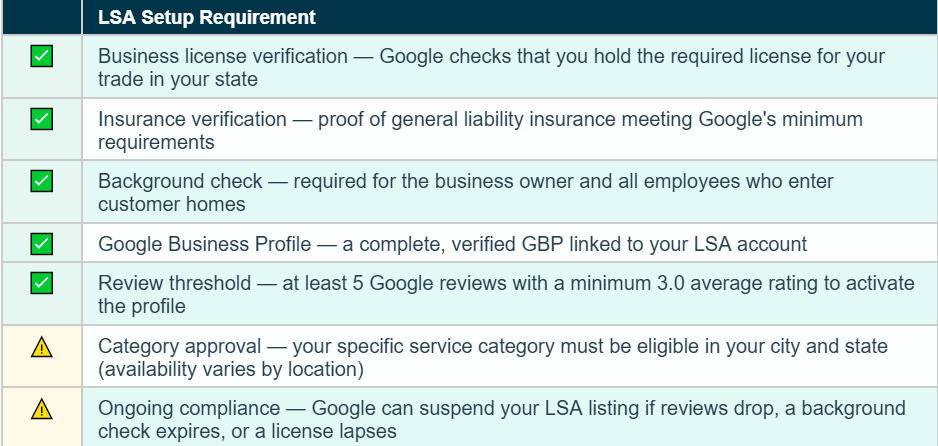
The approval process typically takes 1–4 weeks. Once approved, your LSA profile remains active as long as you maintain the requirements above. The Google Screened badge — the green checkmark that appears on your listing — is the credibility signal that makes LSA ads dramatically more effective than standard search ads for trust-dependent services like home repairs, legal, and financial services.
Many small businesses we work with at AheadTech360 have been running Google Ads for months without realizing they qualify for LSA — and that they're missing the prime position at the top of the page. If you operate in a qualifying service category and haven't set up LSA, it is almost certainly leaving leads and money on the table. The setup investment is worth it.
Here is how the two products compare across every dimension that matters to a local small business:
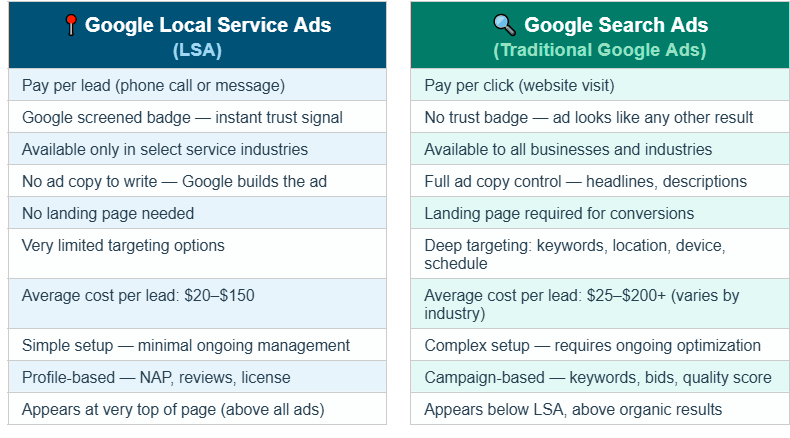
The most confusing part of comparing LSA and Google Ads is that they use different pricing models — one charges per lead, the other per click. To compare them fairly, you need to convert everything to cost per lead (CPL).
LSA charges a flat amount per qualified lead — a phone call of a minimum duration or a direct message through the ad. Google sets lead prices by category and location. Typical ranges in 2026:
Home services (plumbing, HVAC, electrical): $20–$80 per lead
Roofing and contractors: $30–$100 per lead
Legal services: $50–$150 per lead
Financial services: $30–$80 per lead
Cleaning services: $15–$40 per lead
Importantly, LSA allows you to dispute leads that don't meet Google's definition of a valid lead — wrong service area, wrong service type, spam calls. Disputed leads are reviewed by Google and refunded if the dispute is upheld. This adds a layer of cost protection that standard Google Ads doesn't offer.
Traditional Google Ads charges per click. Your cost per lead is calculated by: (Cost Per Click) divided by (Landing Page Conversion Rate). Example: if your CPC is $8 and your landing page converts 15% of visitors into leads, your cost per lead is $8 / 0.15 = $53.
The same click-to-lead math means your cost per lead can vary widely based on how well your landing page is optimized. A well-optimized campaign with a high-converting landing page can generate leads at $25–$45. A poorly optimized campaign can run $80–$150 per lead for the same keywords.
When you run LSA and Google Search Ads simultaneously, you can use your Google Ads data to identify which service types and keywords generate the highest close rates — and feed that intelligence back into your LSA budget allocation. LSA handles the highest-intent, trust-dependent leads at the top of the page. Google Search Ads capture the broader search volume below. The combined CPL across both channels is almost always lower than running either one in isolation, because you're filling the entire funnel simultaneously.
The answer depends on your business type, budget, goals, and how much control you want over your advertising. Use this decision guide:
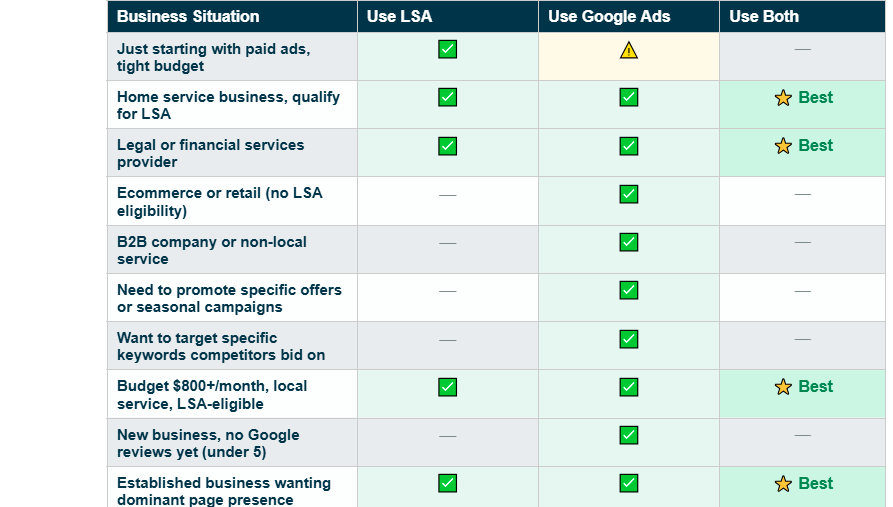
The key principle: if you are eligible for LSA and your monthly budget is $800 or above, running both products is almost always the highest-ROI strategy. They are not competitors for your budget — they serve complementary purposes at complementary positions on the page.
The one scenario where running both doesn't make sense: if your total monthly budget is under $500. In that case, start with Google Search Ads to build keyword data and optimize your landing page first. Once you're generating consistent leads and have enough reviews to qualify, add LSA as a second channel on top of a proven foundation.
At AheadTech360, our standard recommendation for qualifying home service businesses with a $1,000+ monthly budget is a 60/40 split: 60% of budget to Google Search Ads for full keyword coverage and targeting control, 40% to LSA for the top-of-page trust placement and pay-per-lead efficiency. After 90 days, we review performance and rebalance based on which channel is delivering the lower CPL for that specific client's market.
Google Local Service Ads and Google Search Ads are not the same product and they are not interchangeable. LSA is a simple, trust-forward, pay-per-lead product for verified local service businesses — it rewards credibility with the best position on the page. Google Search Ads is a powerful, customizable, keyword-driven platform for any business that wants precise control over targeting, messaging, and budget.
If your business is LSA-eligible, the question is not 'which one should I use?' The question is 'how do I run both effectively?' LSA captures the highest-intent local leads at the top of the page with the Google Screened trust signal. Google Search Ads captures the broader search volume below, with full control over keywords, ad copy, and audience targeting.
Together, they give a local service business the most dominant possible paid presence on Google — and that dominance compounds over time as your LSA reviews grow, your Quality Scores improve, and your cost per lead decreases through optimization.
The goal is not to pick a winner. The goal is to own the page.