We helped 75+ brands generate $1.56M+ in revenue. Average ROI: 240% in Year 1
If you have been running Google Ads for more than a few weeks, you have probably looked at your cost-per-click and thought: there must be a way to pay less for this.
There is. And the good news is that reducing your CPC does not require reducing your visibility or accepting lower-quality traffic. Done correctly, it means paying less for the same or better results — because Google's auction is designed to reward relevance, not just budget.
The businesses paying the highest CPCs in any market are almost never the ones with the best campaigns. They are often the ones with the worst Quality Scores, the broadest keyword targeting, and no negative keyword list. Fixing those things can cut your CPC by 30–50% without changing your bid strategy at all.
Here are the 9 strategies that consistently work — starting with the ones that make the biggest difference, fastest.
At AheadTech360, the first thing we audit in any new Google Ads account is Quality Score. In nearly every account we inherit from a previous agency or from a self-managed setup, we find keywords running at Quality Score 4 or below. On a $5 industry average CPC, a Quality Score of 4 means paying $8.35 per click. A Quality Score of 8 on the same keyword means paying $3.75. That difference alone — before any other optimization — often saves clients 40–50% of their monthly ad spend.
Quality Score (1–10) is Google's measure of how relevant your ad is to the search query. A higher Quality Score directly reduces your actual CPC through Google's auction formula. Three things determine your Quality Score: Expected CTR (how likely people are to click your ad), Ad Relevance (how closely your ad matches the keyword), and Landing Page Experience (how well your page delivers on the ad's promise). Focus here first — a Quality Score jump from 4 to 8 can cut your CPC in half on the same keyword.
Most Google Ads accounts have ad groups containing 15–30 loosely related keywords, all served by the same generic ad. This tanks ad relevance scores. Instead, group tightly related keywords — ideally 2–5 per ad group — and write ad copy that speaks directly to that specific search. A searcher typing 'emergency plumber Dallas' seeing an ad that says exactly 'Emergency Plumber Dallas — Here in 60 Min' has a dramatically higher CTR than seeing a generic 'Professional Plumbing Services' ad.
Every click on an irrelevant search query wastes money and lowers your CTR — which hurts your Quality Score. Negative keywords tell Google which searches NOT to show your ad for. A plumber in Phoenix does not want to pay for clicks from people searching 'plumber jobs Phoenix' or 'DIY plumbing repair.' Add negative keywords before you launch, review your search term report weekly, and add new negatives whenever you see irrelevant queries. A well-maintained negative keyword list typically reduces wasted spend by 20–35%.
Google Ads has three keyword match types: Broad Match (shows for loosely related queries), Phrase Match (shows when your phrase is part of the search), and Exact Match (shows only for very specific queries). Broad match generates the most impressions but the lowest relevance and the highest wasted spend. Moving more of your budget to Phrase and Exact match keywords typically increases CTR, improves Quality Score, and reduces the CPC on your remaining broad match keywords by improving account-wide performance metrics.
If your business generates leads primarily during business hours, you are almost certainly paying full CPCs for clicks at 2am that never convert. Set bid adjustments by time of day and day of week: reduce bids by 50–80% during off-hours and increase them during your peak conversion windows. This does not reduce clicks during your best hours — it just stops you from wasting money on low-converting times when your CPC should reflect lower value.
If you serve a wide geographic area but some locations convert at much lower rates, you are probably overpaying for those locations. Review your location performance report and reduce bids by 30–50% in areas with high CPC but low conversion rates. Increase bids in your highest-converting locations. This often reveals that 20% of your service area generates 60% of your revenue — and you should be spending your budget there, not spread equally across the full radius.
Landing Page Experience is one-third of your Quality Score. A page that loads slowly on mobile, does not match the ad's specific promise, or makes it hard to find the CTA receives a low landing page experience score — which increases your CPC even if your ad copy is excellent. Run your landing pages through Google PageSpeed Insights. Target a 70+ mobile score. Make sure every ad group points to a page specifically tailored to that ad's promise — not your generic homepage.
A higher CTR directly improves your Expected CTR component of Quality Score — which reduces your CPC. Running 3–4 ad variations simultaneously and pausing the underperformers is one of the simplest and highest-impact optimizations available. Test one variable at a time: headline 1 first, then headline 2, then description. A 0.5% improvement in CTR can meaningfully improve your Quality Score and reduce your CPC over 2–4 weeks.
Once your campaign has generated at least 30–50 tracked conversions, switching from Manual CPC to Target CPA or Target ROAS bidding allows Google's algorithm to optimize bids at the auction level — adjusting your bid for each individual search based on the likelihood of conversion. This typically reduces CPA by 15–25% compared to manual bidding, because Google can factor in hundreds of signals (device, time, location, audience) that a manual bidder cannot process in real time.
These strategies compound when applied together. Here's what a realistic CPC optimization journey looks like for a local service business starting with a $6 average CPC:
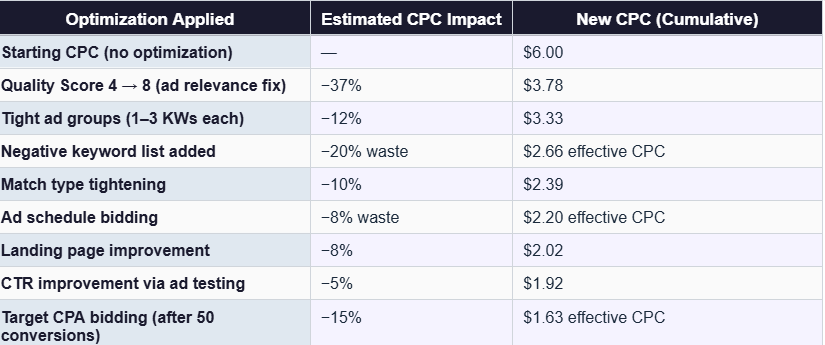
Starting at $6.00 per click and applying all nine strategies progressively: you end up at approximately $1.63 effective cost per click — a 73% reduction without changing your industry, your market, or your budget. The improvement is not theoretical — it reflects what we consistently see when auditing and rebuilding underperforming Google Ads accounts.
One mistake that negates all of this work: setting campaigns to 'maximise clicks' bidding. This strategy tells Google to get you as many clicks as possible regardless of their quality or conversion likelihood. It reliably produces high click volume at a low CPC — and very low conversion rates because the clicks are not from high-intent searchers. Always optimise for conversions, not clicks. The goal is not the cheapest clicks. It is the most profitable customers.
Paying a high CPC in Google Ads is not inevitable — it is usually a symptom of a campaign structure problem that is entirely fixable. Quality Score is the most powerful lever, and improving it addresses the root cause of most high-CPC accounts.
Apply these nine strategies in order, starting with Quality Score and ad structure, and give each change 2–4 weeks to reflect in your data before evaluating results. The compounding effect of all nine applied together is substantial — and the businesses that invest in this optimization consistently outperform competitors who simply throw more budget at an inefficient account.
Google Ads rewards relevance. Build a relevant, well-structured campaign and Google will reward you with lower CPCs, better positions, and more leads per dollar — permanently.