We helped 75+ brands generate $1.56M+ in revenue. Average ROI: 240% in Year 1
This is one of the most Googled questions in small business marketing — and it gets one of the most useless answers: 'It depends.'
Yes, it depends. But on what, exactly? On how many pages you need? On whether you want an online store? On whether you want someone else to manage it or do it yourself? On whether you need custom features your competitors don't offer?
All of those things. And this guide breaks every single one of them down into plain numbers.
By the end, you'll know the real price ranges for all four types of website builds used by small businesses, what you actually get — and give up — at each budget level, every hidden and ongoing cost most business owners forget to plan for, and exactly how to decide which option makes sense for your specific business right now.
No agency fluff. No bait-and-switch pricing. Real 2026 numbers that help you walk into any web development conversation fully informed.
At AheadTech360, we get asked about website pricing every week. The most common situation we see: a business owner got quoted $800 by one agency and $18,000 by another — for what sounds like the same project. Both quotes can be legitimate. The difference is almost always in what's actually included, what platform is being used, and how much customization is really required. This guide gives you the framework to evaluate any quote you receive.
A website is not a single product. It's a spectrum of solutions ranging from a free DIY page builder to a fully custom-coded platform with integrated business systems. The reason quotes vary from $500 to $50,000 for 'a small business website' is because those words describe completely different things.
Three factors drive most of the price variation:
Customization level — A template-based website uses a pre-built design that gets filled with your content. A custom-built website is designed and coded from scratch for your specific brand, goals, and workflows. Templates are faster and cheaper. Custom builds deliver more differentiation, better performance, and stronger conversion rates — but cost 5–20x more.
Platform complexity — A simple WordPress brochure site costs a fraction of a Shopify ecommerce store with 500 products and integrated inventory management. The platform determines both the build time and the ongoing maintenance cost. Choosing the wrong platform is one of the most expensive web decisions a small business can make.
Who builds it — A freelancer in a low-cost-of-living area charges differently than a US-based boutique agency, which charges differently than a large national agency. Quality, communication, support, and accountability all vary significantly across these tiers — and the lowest price does not always represent the best value.
The most expensive website mistake small businesses make is not overspending — it's underspending on the wrong solution. A $900 DIY website that takes 40 hours of your own time to build, doesn't rank on Google, loads slowly on mobile, and can't generate leads is more expensive than a $4,500 professionally built CMS site that starts generating customers within 60 days. Always evaluate total cost of ownership, not just upfront price.
Here are the four main tiers of website investment for small businesses in the US in 2026, with honest assessments of what each delivers and where each falls short:
$0 – $500 / year
What you get:
Basic online presence in 1–3 days. Drag-and-drop editor, mobile-responsive templates, built-in hosting and SSL. Sufficient for a simple 3–5 page brochure site with contact form. Low monthly cost ($12–$40/month for a paid plan).
What you sacrifice: Your time (typically 15–40 hours to build properly). Generic design that looks like thousands of other websites. Very limited SEO capabilities — difficult to rank for competitive keywords. No custom functionality. Harder to scale as your business grows.
Best for: Businesses testing their concept, very early-stage startups with near-zero budget, service providers who only need a basic 'we exist' presence and generate all leads through referrals.
$500 – $3,000 (one-time build)
What you get:
Professional appearance based on a quality premium theme. Basic on-page SEO setup. Mobile-optimized. Contact forms, gallery, basic service pages. Timeline: 1–4 weeks. For Shopify: product catalog with payment processing included.
What you sacrifice: Cookie-cutter design — your site looks similar to others using the same theme. Limited differentiation. SEO potential capped by template structure. Customization is expensive after the fact. Quality varies significantly by who builds it.
Best for: Local service businesses needing a professional web presence on a limited budget. Early-stage ecommerce businesses testing product-market fit on Shopify. Businesses upgrading from a DIY website builder for the first time.
$3,000 – $10,000 (one-time build)
What you get:
Unique, brand-specific design built from scratch. Strong on-page SEO architecture. Fast load times. Custom page layouts, advanced contact/booking forms, blog setup, local SEO optimization. Full content management — update everything yourself after launch. Timeline: 3–8 weeks.
What you sacrifice: Higher upfront investment. Requires proper brief and clear project scope to stay on budget. Ongoing maintenance costs ($50–$200/month for updates, security, and support).
Best for: Established local service businesses ready to invest in a site that generates leads. Growing ecommerce businesses needing a scalable Shopify store. Any business for whom their website is a primary customer acquisition channel.
$10,000 – $50,000+ (one-time build)
What you get:
100% unique platform built specifically for your business logic. Custom user portals, booking systems, inventory management, third-party API integrations (payment gateways, CRM, ERP). Infinitely scalable. Maximum performance, security, and conversion optimization. Built to your exact specifications. Timeline: 2–6 months.
What you sacrifice: Significant investment of time and budget. Requires detailed requirements documentation. Ongoing development costs for new features. Not suitable for businesses that simply need an informational or brochure website.
Best for: Businesses with complex workflows that no off-the-shelf platform can handle. SaaS companies, marketplaces, booking platforms, businesses needing ERP/CRM integration, or companies whose competitive advantage lives in their web platform's functionality.
Here's an honest side-by-side of what you gain and what you give up at each investment level. Understanding these trade-offs before you make a decision is what separates informed buyers from businesses that end up rebuilding their site 18 months later:
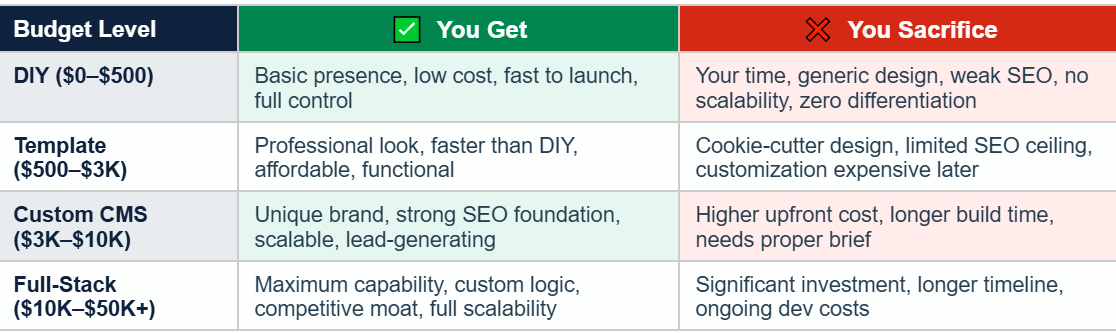
Don't ask 'how much can I spend?' Ask 'what does my website need to do for my business in the next 2 years?' If the answer is 'generate leads from Google search,' a custom CMS build ($3K–$10K) will deliver ROI that a $900 template site cannot. If the answer is 'I just need somewhere to send people who already know about me,' a template build is completely sufficient. Match the investment to the job the website needs to do — not just the budget you have available.
The build cost is only part of what a website actually costs. Most business owners focus entirely on the upfront development quote and are surprised by the recurring costs that follow. Here's a complete picture of what to budget for beyond the initial build:
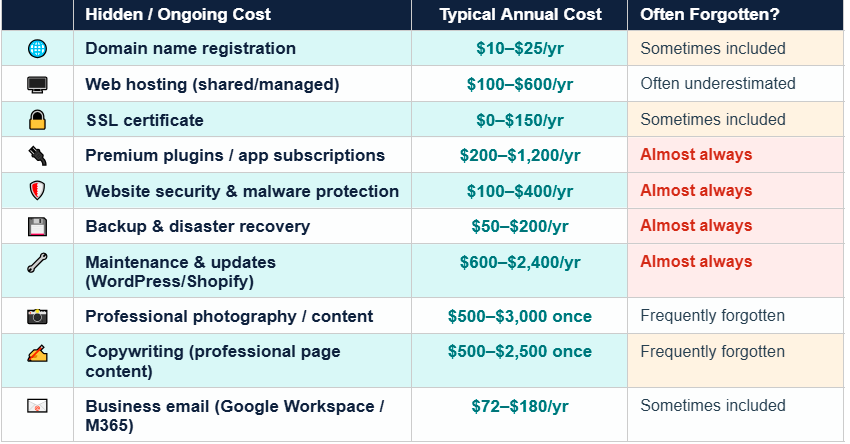
Total realistic annual ongoing cost for a professionally maintained small business website: $1,200–$5,000/year depending on platform, plugin stack, and whether you handle maintenance yourself or outsource it. Factor this into your total cost evaluation before comparing build quotes.
A common scenario we see at AheadTech360: a business owner gets a $1,200 website build quote from a freelancer, accepts it, and then discovers 12 months later they also owe $800 for hosting, $400 for a premium theme license renewal, $300 for security, and $600 for the 8 hours of emergency fixes after a plugin update broke the site. Their $1,200 website actually cost $3,300 in year one. Always ask for a full first-year cost breakdown — build plus all recurring costs — before signing any web development agreement.
AheadTech360 builds websites across all four tiers — from CMS-based builds on WordPress and Shopify to fully custom full-stack applications. Our approach is the same regardless of budget: we scope the project transparently, recommend the right platform for your specific business goals, and deliver a website that functions as a customer acquisition tool — not just a digital business card.
CMS-Based Development (WordPress / Shopify) — For businesses that need a professional, SEO-optimized, easy-to-manage website without the complexity and cost of full custom development. Ideal for local service businesses, professional service providers, and growing ecommerce stores.
Full-Stack Custom Development — For businesses with unique requirements that no off-the-shelf platform can handle — custom booking systems, client portals, API integrations, or web applications with complex business logic built in.
ERP / CRM Integration — For businesses ready to connect their website to their business operations — inventory, customer management, invoicing, and workflow automation — through platforms like HubSpot, Odoo, or Salesforce.
App Development — For businesses whose competitive advantage requires a dedicated mobile or web application rather than a traditional website.
Every web development project at AheadTech360 starts with a discovery call where we ask one question before we talk about platforms or price: 'What does success look like for this website in 12 months?' The answer to that question determines everything — the platform, the features, the budget, and the timeline. A website that looks good but doesn't achieve your business goals is a failed investment regardless of how much it cost.
Website costs in 2026 range from $0 to $50,000+ — and every point on that spectrum can be the right answer, depending on what your website needs to do for your business. The mistake is choosing based on upfront price alone rather than total value delivered.
A $5,000 website that generates 3 new customers per month has a payback period measured in weeks for most service businesses. A $900 website that no one finds, no one trusts, and that converts nobody is just an expense. Budget for the outcome you need, not the minimum you can get away with.
The right website for your business is the one that earns back its cost — and then keeps earning. Everything else is just a placeholder.