We helped 75+ brands generate $1.56M+ in revenue. Average ROI: 240% in Year 1
Ecommerce SEO services include technical SEO (site speed, crawlability, structured data), product and category page optimization, keyword-driven content, internal linking, link building, and monthly performance reporting — built specifically around how shoppers search and how ecommerce platforms like Shopify and WooCommerce structure pages.
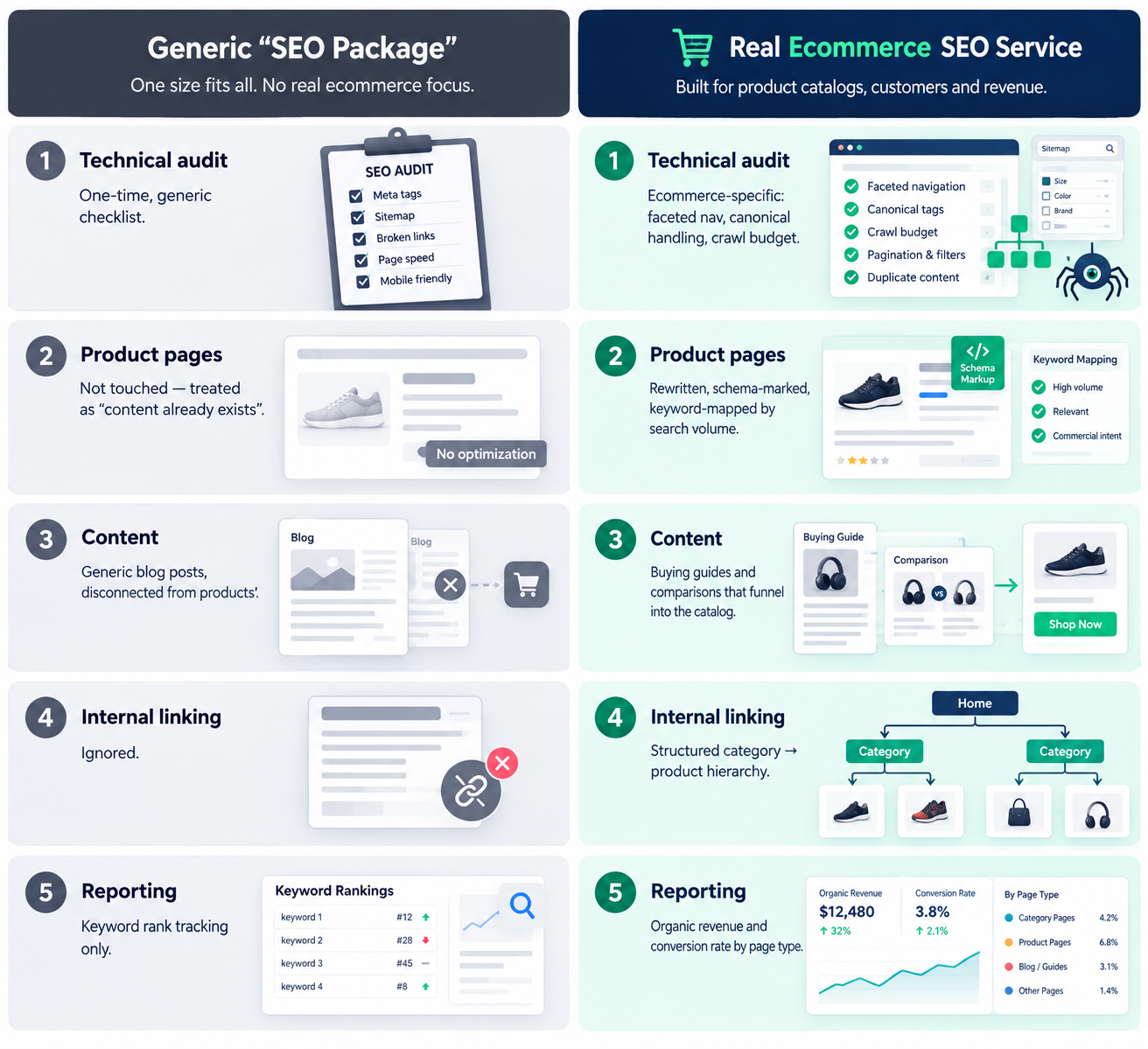
Most "SEO packages" you'll see quoted online are written for a local plumber or a law firm, then relabeled for ecommerce. That's the problem. An ecommerce store doesn't have ten pages — it has hundreds or thousands, most of them thin product pages, duplicate variants, and category pages Google can't tell apart. A real ecommerce SEO service is built for that scale. Here's exactly what should be in it.
The ecommerce stores we audit most often have the same blind spot: their homepage and top category pages are decent, but 80%+ of their traffic potential is sitting in product pages Google has never properly indexed — thin descriptions, duplicate content pulled straight from the manufacturer, no schema. Fixing the top 20% of product pages by search volume usually moves the needle faster than any blog content plan.
A complete ecommerce SEO service covers five core pillars: technical SEO, on-page/product SEO, content, internal linking, and link building — plus ongoing reporting that ties all five back to organic revenue, not just rankings.
Here's what each one actually means in practice:
Technical SEO — site speed, crawlability, indexation, structured data (Product schema, review schema), mobile performance, and fixing the duplicate-content issues that color/size variants create automatically.
Product & category page optimization — unique titles, meta descriptions, headings, and product copy for pages that usually ship with manufacturer boilerplate.
Content & keyword strategy — buying-guide and comparison content that captures shoppers before they've picked a product, not just after.
Internal linking — connecting category → subcategory → product pages so Google (and shoppers) can find your best-selling items in two clicks, not eight.
Link building & authority — earning links to category and collection pages, not just the homepage, since that's what actually ranks in ecommerce.
Reporting — monthly tracking of organic revenue and conversion rate by page type, not just keyword position.
Technical SEO for ecommerce means making sure Google can crawl, index, and understand a site that often has thousands of near-duplicate pages — something most general SEO checklists never account for.
The issues that show up again and again on ecommerce sites:
Faceted navigation creating infinite duplicate URLs. Filtering by size, color, or price generates a new URL every time, and without canonical tags or parameter handling, Google ends up crawling thousands of near-identical pages instead of your actual catalog.
Out-of-stock and discontinued products left live (or worse, deleted with no redirect). Both waste crawl budget and kill link equity that page had earned.
Page speed on product pages, which usually load more images and third-party scripts (reviews widgets, upsell apps, chat) than any other page type on the site.
Missing or broken Product schema, which is what makes star ratings, price, and availability show up directly in search results.
Product page optimization means rewriting manufacturer-supplied descriptions into unique copy, adding the specific terms shoppers actually search, and marking up reviews, price, and availability with schema — because a page Google sees as duplicate content will not rank no matter how much authority the domain has.
Category pages get the same treatment, but with more weight: they're usually the pages capturing the "buying" keywords (the broader, higher-volume searches like "[product] for [use case]") while individual product pages capture the narrower, bottom-of-funnel searches.
Ecommerce content strategy fills the gap between "browsing" and "buying" — buying guides, comparison posts, and "best [category] for [use case]" content that ranks for the research-stage searches your product pages are too narrow to capture, and that funnel traffic back into your catalog.
This is also where most ecommerce sites under-invest. Product and category pages cover the transactional keywords. Content covers the commercial and informational ones sitting just above them in the funnel — and without it, a store is only fishing in the narrowest part of the search demand for its own products.
Internal linking for ecommerce means every category page links to its top-performing subcategories and products, every product page links back to its category and to genuinely related items, and no page on the site sits more than three clicks from the homepage.
This does two things at once: it tells Google which pages matter most (the pages with the most internal links are treated as the most important), and it moves shoppers toward checkout instead of a dead end.
Ecommerce link building means earning links to category and collection pages — not just the homepage — through digital PR, product gifting to relevant publications, partnerships, and content worth citing, since collection pages are what actually rank for the high-value commercial searches.
Buying cheap directory links or "guest post" packages does the opposite: it flags the domain as low-quality without moving the pages that generate revenue.
Ecommerce SEO services typically run $1,000–$5,000+ per month depending on catalog size, current site health, and competition in your category — smaller catalogs with a handful of product lines sit at the lower end, while stores with thousands of SKUs or highly competitive niches need more hands-on monthly work.
Pricing below that range is usually a sign the service is templated rather than built around your actual catalog — a real audit of a 2,000-product Shopify store takes real hours, and that cost shows up somewhere in the price.
Ask specifically how they approach product pages at scale, not just "do you do SEO" — an agency that can't explain their process for a 500+ SKU catalog without manually rewriting every page one by one doesn't have an ecommerce-specific process, they have a general SEO process with "ecommerce" added to the name.
Beyond that:
Ask for an ecommerce-specific case study, not a generic "we improved rankings" example.
Ask how they prioritize which product pages get attention first. Volume-based prioritization beats "we'll get to all of them eventually."
Confirm reporting ties to organic revenue, not just keyword rank — rank means nothing if it isn't converting.
Ask what platform experience they have (Shopify, WooCommerce, Magento) — the technical fixes are different on each.