We helped 75+ brands generate $1.56M+ in revenue. Average ROI: 240% in Year 1
You're paying an SEO agency — or considering it — but when someone asks you what they actually do each month, you're not entirely sure how to answer.
That's more common than you'd think. SEO is one of the few services where the work happens largely invisibly — inside your website's code, in content drafts, in outreach emails to other websites, in algorithm adjustments you can't see directly. And because results take months to appear, there's a long window where business owners pay invoices without a clear picture of what's being done for them.
Some agencies exploit that ambiguity. Others are genuinely doing valuable work that's simply hard to see in the short term. The way to tell the difference is to understand exactly what a legitimate SEO agency should be doing — so you can evaluate whether yours is actually doing it.
This guide breaks down every component of SEO agency work — month by month — so you can hold your agency accountable and understand what good work actually looks like.
The most common complaint we hear from businesses that have worked with previous SEO agencies: 'We paid them for 12 months and never really understood what they were doing.' A legitimate agency should be able to explain every task it performs in plain English, connect every task to a business outcome, and show you evidence that the work happened. If your current or prospective agency can't do that — it's a problem.
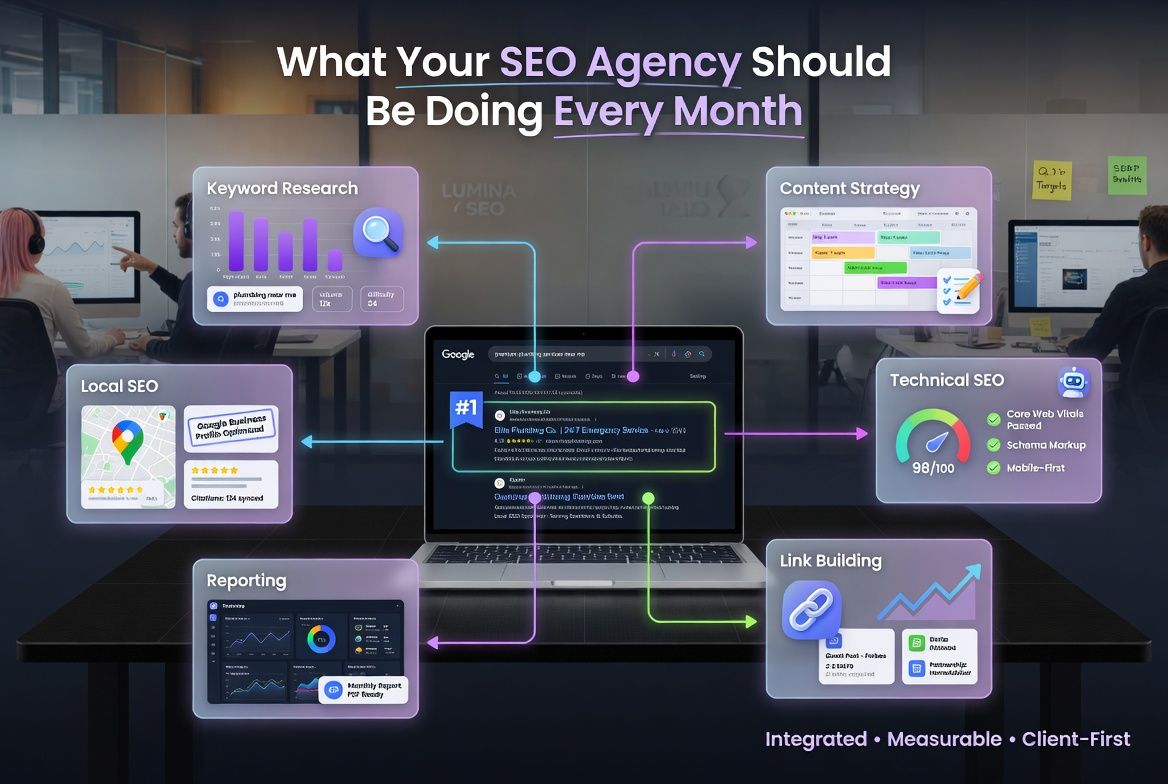
Keyword research is the foundation of everything an SEO agency does. Before writing a word of content or building a single link, a legitimate agency conducts comprehensive research to identify: which keywords your target customers actually use when searching for your services, the search volume and competition level of each keyword, which keywords represent buyer intent versus casual research, and gaps between what you currently rank for and what you should rank for.
This research informs every other piece of work — what content to create, which pages to optimize, and which queries to target with link building. An agency that starts 'doing SEO' without delivering a clear keyword strategy document first is working without a map.
Before content or links can do their job, your website needs to be technically sound. Technical SEO work includes: auditing and fixing crawlability issues (pages Google can't access), resolving indexing problems (pages missing from Google's index), improving page speed and Core Web Vitals scores, implementing schema markup for rich results, fixing broken links and redirect chains, ensuring HTTPS is properly configured, and optimizing for mobile-first indexing.
Most legitimate agencies deliver a technical audit in the first month and then implement the fixes progressively. Technical SEO is not one-time work — every website update, plugin change, or content addition can introduce new technical issues that need monitoring.
On-page SEO is the optimization of individual pages to better match the queries they're targeting. This includes: rewriting title tags and meta descriptions to include target keywords and improve click-through rates, restructuring heading hierarchies (H1, H2, H3), adding and optimizing internal links between relevant pages, improving content depth and relevance for target keywords, optimizing images with descriptive alt text, and improving URL structure.
For existing businesses with established websites, on-page optimization often produces the fastest ranking improvements — because the changes are implemented immediately and Google recrawls the updated pages within days.
Content is how your website earns organic traffic beyond your core service pages. A legitimate SEO agency doesn't just create content — it creates strategically planned content designed to rank for specific keywords, answer specific questions, and move readers toward specific conversion actions.
This includes: service pages written with keyword research informing the copy, location pages targeting specific cities or service areas you operate in, blog articles targeting informational keywords your customers search, FAQ content structured for AEO and AI Overview citation, and content updates to improve existing underperforming pages.
One distinction that separates good agencies from mediocre ones: the difference between content written to rank and content written to convert. Content written purely to rank may attract traffic but fail to generate leads because it doesn't speak clearly to the customer's situation or make a compelling case for your service. Good SEO content does both — it matches the searcher's intent well enough to rank, and speaks to their specific problem and your solution clearly enough to convert.
Links from other websites to yours are one of the strongest signals Google uses to evaluate authority and trustworthiness. A legitimate agency builds links through: outreach to relevant industry websites, local directories, and local news outlets, creating content that other sites naturally want to link to, digital PR — getting your business mentioned in articles, roundups, and resource pages, fixing broken links on other sites by suggesting your content as a replacement, and building relationships with complementary businesses for mutual linking opportunities.
The key quality indicator: links should come from websites that are topically relevant to your industry or geographically relevant to your market. A plumber ranking in Phoenix benefits from links from home improvement sites, local news sites, and Phoenix-area business directories — not links from random blogs with no relationship to plumbing or Arizona.
For small businesses serving a local area, local SEO is a dedicated discipline within broader SEO work. It includes: Google Business Profile optimization and ongoing management (responding to reviews, posting updates, adding photos, keeping hours current), citation building and NAP consistency across directories, optimizing for 'near me' and local intent searches, building location-specific pages if you serve multiple areas, and encouraging and managing customer reviews.
Local SEO often produces the fastest visible results for service businesses — because competing for the local 3-pack (the map results) involves fewer competitors than national keyword rankings and responds quickly to profile completeness and review volume improvements.
Here's a realistic timeline of what a legitimate SEO agency delivers across the first 6 months of an engagement for a small local service business:
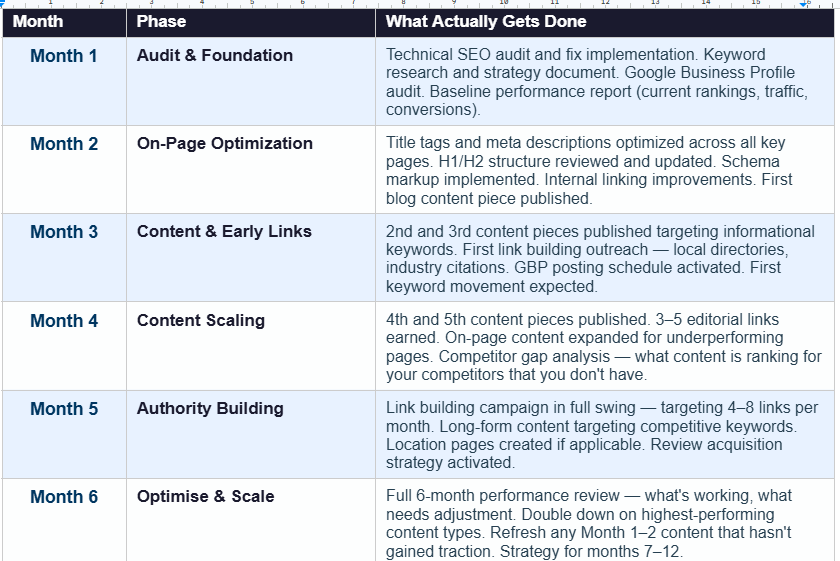
A common pattern with bad agencies: high activity in Month 1 (lots of reports, lots of 'setup work') followed by minimal deliverables in subsequent months while invoicing continues at full rate. If your agency's month-2 and month-3 deliverables are not clearly specified and delivered, ask explicitly: 'What work was completed this month and can you show me?' Legitimate agencies keep detailed work logs and are happy to share them.
Every month, your SEO agency should deliver a report that tells you what happened, what changed, and what's planned next. Here's what should be in it — and why each item matters:
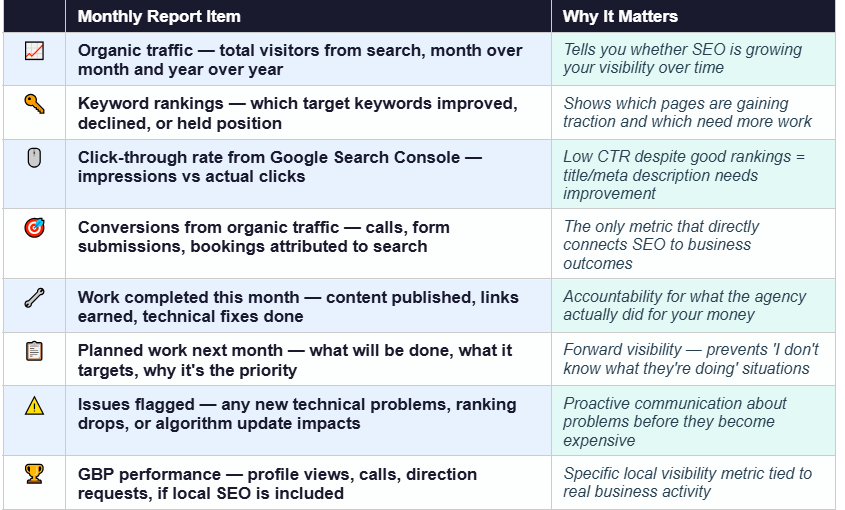
Organic conversions — leads, calls, or sales that came directly from organic search traffic. Everything else (rankings, traffic, DA) is a leading indicator. Organic conversions are the lagging indicator that tells you SEO is generating real business value. If your agency reports extensively on rankings and traffic but never discusses conversions, ask them to set up goal tracking in Google Analytics so you can see exactly how many business inquiries your SEO investment is generating. This single metric — cost per organic lead — is the clearest measure of whether your SEO is worth what you're paying for it.
A legitimate SEO agency does a lot of work that's hard to see — research, writing, outreach, technical fixes — and produces results that compound over months rather than appearing overnight. That combination makes it easy for bad actors to hide inactivity behind jargon and patience.
But when you understand exactly what good SEO work looks like — the keyword research, the content, the technical foundation, the links, the local optimization — you can evaluate any agency's deliverables against a clear standard. And when your monthly report shows organic conversions growing month over month, you'll have the clearest possible evidence that the work is paying off.
SEO is a long game. The businesses that win it are the ones who understand what good work looks like, hold their agency accountable to delivering it, and stay patient long enough to see the compounding effect of 12 months of consistent, high-quality SEO investment.
Good SEO is invisible while it's working — and unmistakable when it's not.