We helped 75+ brands generate $1.56M+ in revenue. Average ROI: 240% in Year 1
Most small business owners who try running their own Google Ads or Facebook Ads share a similar story.
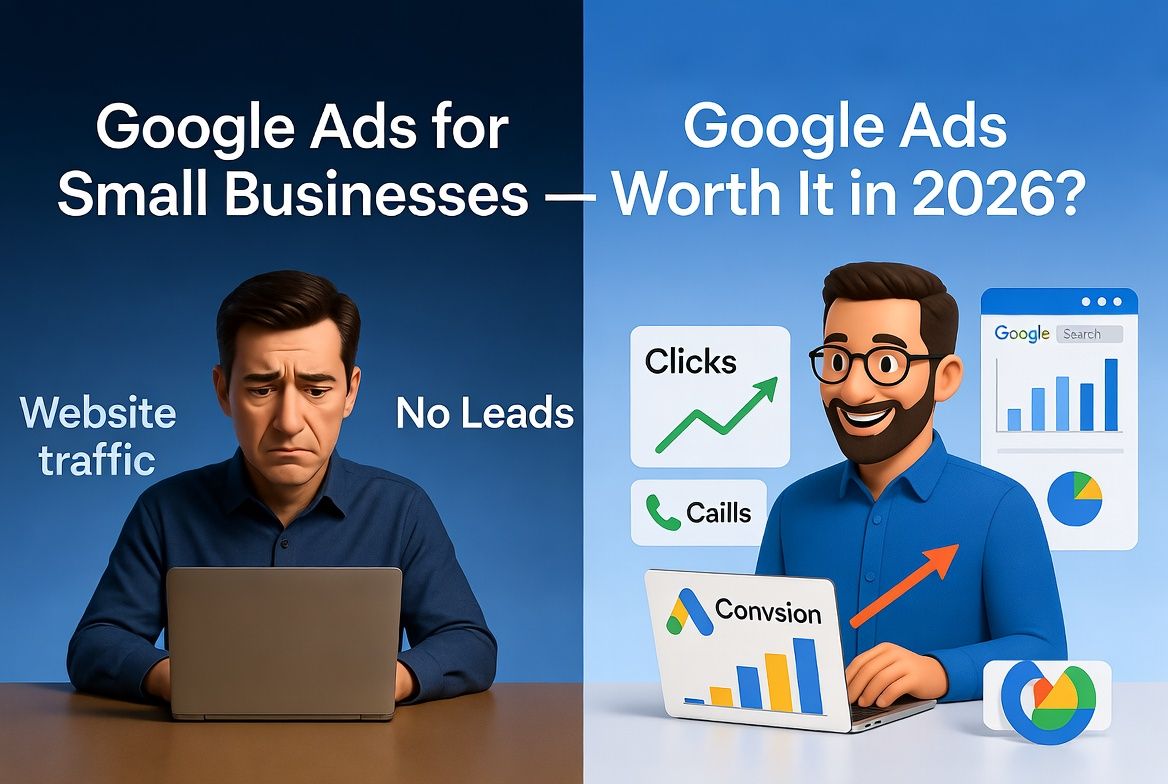
They set up the campaign, spend a few hundred dollars over a couple of weeks, get a handful of clicks, and zero leads. They conclude that paid ads don't work — and move on.
What actually happened? In most cases, not a single thing was technically wrong with the platform. What was missing was management.
PPC management is the ongoing process of running, optimizing, and improving a paid ad campaign. It's not a one-time setup. It's a weekly discipline — and it's the difference between a campaign that drains your budget and one that consistently generates leads at a profitable cost.
In this guide, we'll break down exactly what PPC management involves, what a good PPC manager does every week, and how to know whether you should handle it yourself or bring in a professional.
At AheadTech360, we've taken over dozens of ad accounts that business owners ran themselves for months with poor results. In almost every case, the problem wasn't the budget or the platform — it was a handful of fixable mistakes that were quietly burning through money every single day. This guide will show you exactly what those mistakes are.
PPC stands for Pay-Per-Click. It's a model of online advertising where you pay each time someone clicks your ad — as opposed to paying for impressions (views) regardless of whether anyone engages.
The most common PPC platforms for small businesses are:
Google Ads — Ads that appear in Google search results, Google Maps, YouTube, and across Google's display network.
Meta Ads (Facebook + Instagram) — Ads that appear in Facebook and Instagram feeds, stories, reels, and the Audience Network.
Microsoft Advertising (Bing Ads) — Smaller volume than Google but often lower CPCs and less competition — worth considering for certain industries.
PPC management refers to the professional handling of these campaigns — the strategy, setup, daily monitoring, and continuous optimization that turns ad spend into measurable business results.
This is the part most people don't realize. Running a paid ads campaign is not like turning on a faucet. There is a significant amount of ongoing work involved — and skipping any of it costs you money.
Every AheadTech360 PPC client gets a weekly task log and a monthly performance report — written in plain English, not agency jargon. We believe you should always know exactly what we're doing, why we're doing it, and what it's returning for your business.
These are the mistakes we see most often when we audit ad accounts that business owners managed themselves:
What happens: Google matches your ads to a much wider range of searches than you expect. Without a negative keyword list, your budget gets spent on irrelevant clicks from people who will never buy from you.
The fix: Add a thorough negative keyword list from day one. Review your Search Terms report weekly and add new negatives as irrelevant queries appear.
What happens: Broad match keywords tell Google to show your ad for anything remotely related to your keyword. This sounds like more reach — but it's usually more wasted spend. Your 'HVAC repair' keyword could trigger for 'how to fix AC yourself.'
The fix: Start with phrase match and exact match keywords. Only use broad match once you have enough data to understand how Google is interpreting your keywords.
What happens: Most business homepages are built for general visitors — not for people who just clicked a specific ad. Sending paid traffic to your homepage instead of a dedicated landing page is one of the biggest conversion killers in paid advertising.
The fix: Build a dedicated landing page for each campaign that matches the exact promise made in the ad. One clear message, one clear call to action.
What happens: Without conversion tracking, you have no idea which keywords, ads, or audiences are actually generating leads or sales. You're flying blind — spending money without any feedback loop to tell you what's working.
The fix: Set up Google Tag Manager, configure conversion actions for calls and form submissions, and verify tracking is firing correctly before spending a dollar.
What happens: Most DIY campaigns get paused within 2–3 weeks because they 'aren't working.' The reality: most campaigns need 4–6 weeks of data before they can be properly optimized. Giving up early means you never reach the profitable phase.
The fix: Commit to a minimum 60-day testing period. Set realistic expectations — the first month is data collection. Optimization and profitability typically come in months 2–3.
The most expensive PPC mistake isn't running ads wrong — it's running ads without tracking. If you don't know which campaigns are generating real customers, you have no way to cut waste or scale success. Conversion tracking is not optional.
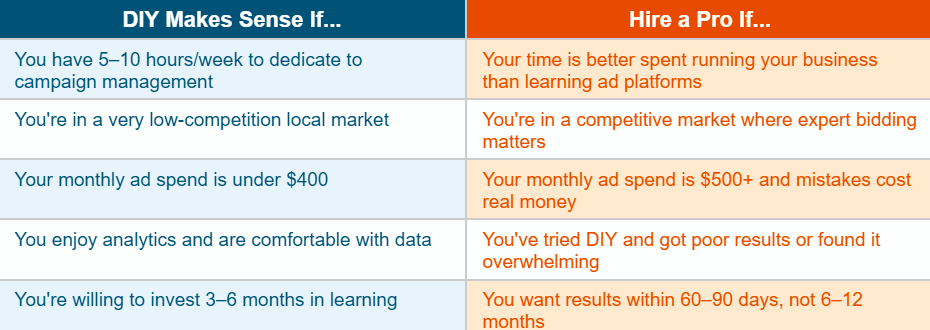
Honest answer: it depends on your time, your technical comfort, and the competitiveness of your market.
Not every agency delivers what they promise. Here's how to separate the good ones from the ones that will take your money and send you a pretty report with no real results:
Transparent reporting. You should receive a clear monthly report showing cost per lead, ROAS, keyword performance, and what actions were taken that month. If an agency can't tell you exactly what they did with your budget, that's a serious red flag.
No long-term lock-in contracts. Agencies confident in their work offer month-to-month or short-term agreements. 12-month contracts that trap you regardless of results benefit the agency, not you.
Conversion tracking set up from day one. Any agency worth hiring will insist on setting up proper conversion tracking before launching a campaign. If they launch without it, they can't prove their results — and neither can you.
Dedicated account manager, not a revolving door. Your campaigns should be managed by a consistent person who understands your business — not passed between junior staff members every few months.
Realistic expectations from the start. An honest agency tells you that month one is testing, and results typically solidify in months 2–3. Any agency guaranteeing specific results from day one is not being straight with you.
At AheadTech360, every client gets a dedicated account manager, monthly performance reports in plain English, and a month-to-month agreement. We don't need long contracts because we focus on delivering results that make our clients want to stay. Our average client retention speaks for itself.
PPC management is not a set-it-and-forget-it task. It's a weekly discipline that requires keyword research, bid adjustments, ad copy testing, landing page optimization, and rigorous tracking — all working together to turn your ad spend into a measurable return.
Business owners who try to manage campaigns between client calls, on weekends, or without the right training almost always underperform. Not because they're not smart enough — but because effective PPC management requires both expertise and consistent time investment.
The good news: when PPC management is done right, it becomes one of the most reliable and scalable lead generation systems a small business can build. You know exactly what each lead costs. You know exactly how much revenue those leads generate. And you can grow your investment in direct proportion to your results.
Paid ads don't manage themselves. But when managed well, they manage your growth.