We helped 75+ brands generate $1.56M+ in revenue. Average ROI: 240% in Year 1
Imagine this.
You've seen your competitor's ads everywhere. On Google. On Facebook. You decide it's time — you set up your own campaign, put in your credit card, write a few lines of ad copy, and hit launch.
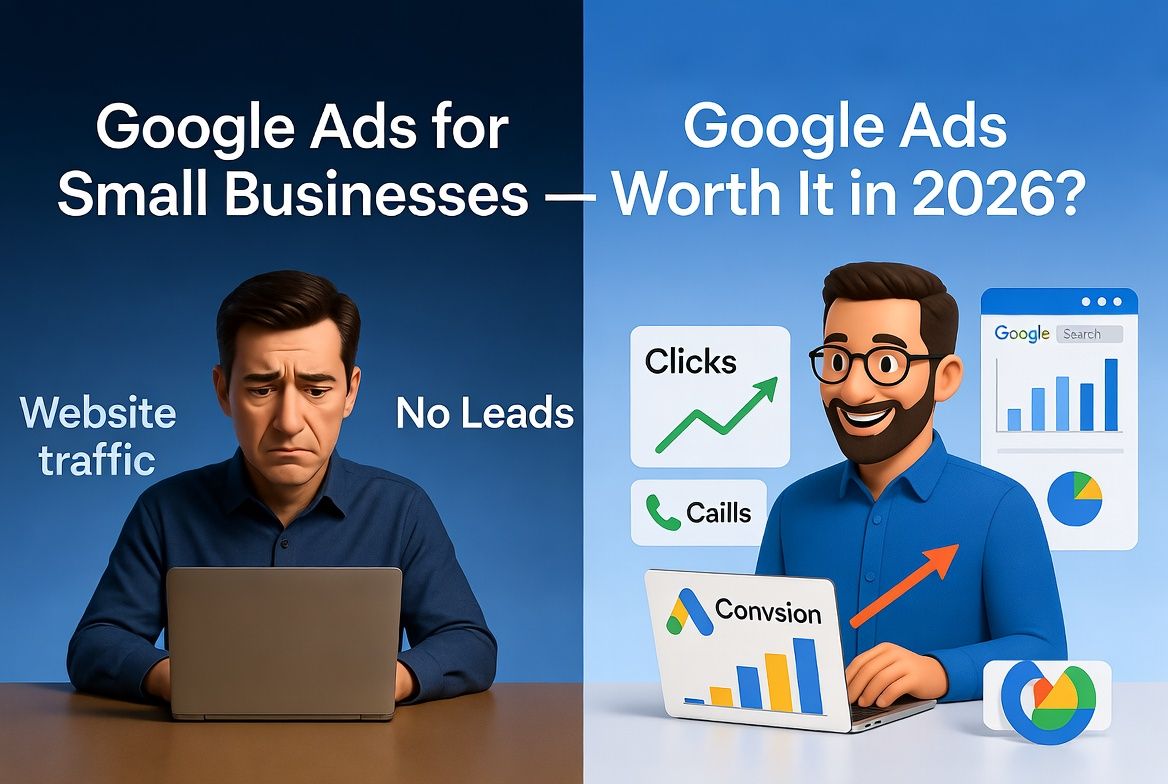
Two weeks later, you've spent $400. You have 47 clicks. And zero leads.
You check the campaign again. It looks fine. The ads are running. The budget is spending. But the phone isn't ringing and the inbox is empty.
So you do what most people do. You assume ads don't work for your type of business. You turn it off. And you go back to word-of-mouth and hoping for referrals.
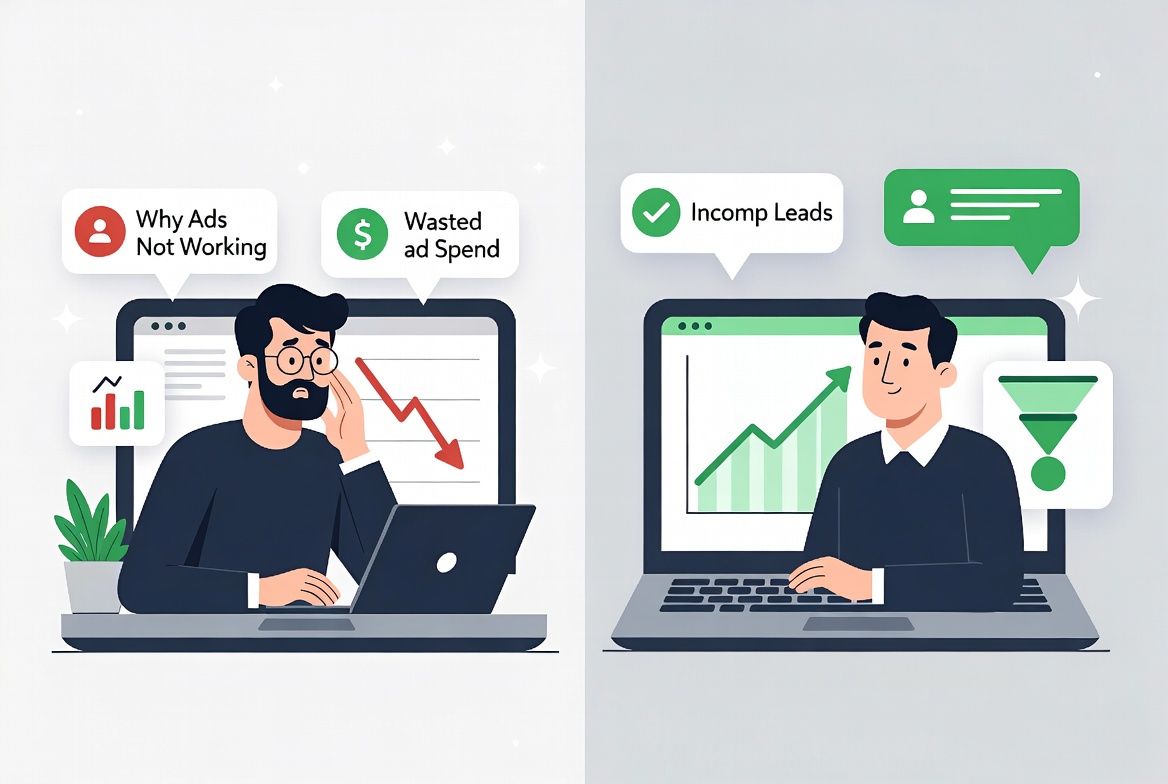
Here's what actually happened: your campaign had at least three of the five problems we're about to cover. None of them were the platform's fault. All of them were fixable. And because you didn't know what to look for, you walked away from a channel that could have been filling your pipeline every single month.
This guide is the one you needed before you launched that campaign. But it's not too late.
At AheadTech360, we audit failed ad accounts every week. The story above isn't a hypothetical — it's a composite of what we hear from almost every small business owner who comes to us frustrated after running ads that didn't deliver. The good news is that in 90% of cases, the fix is straightforward once you know where to look.
Most people blame the platform when their ads don't work.
'Google Ads is too expensive.' 'Facebook Ads stopped working.' 'PPC doesn't work for my industry.'
These statements feel true in the moment — especially when you've just watched money disappear with nothing to show for it. But they're almost never accurate.
Google processes 8.5 billion searches every day. Facebook has 3 billion monthly active users. These platforms work. The businesses running profitable campaigns on them are not lucky or special — they've just avoided the mistakes we're about to cover.
The 5 Real Reasons Your Ads Aren't Generating Results
Your Ad Is Reaching the Right Platform — But the Wrong People
This is the silent budget killer. Your ads are running. They're getting clicks. But the people clicking have no real intention of ever buying from you. On Google, this happens when broad match keywords trigger your ad for searches that have nothing to do with your business. On Meta, it happens when your audience targeting is too wide — reaching people who fit a vague demographic but have zero connection to your offer. The result is spend without results, and the false conclusion that 'the ads aren't working.'
A home cleaning company in Chicago set up Google Ads targeting the broad match keyword 'cleaning.' Their ads appeared for 'cleaning tips,' 'cleaning maid services in India,' and 'cleaning resume template.' Over $600 was spent before they noticed the Search Terms report. Not a single click came from someone looking to hire a cleaner in Chicago.
On Google: use phrase match and exact match keywords only. Pull your Search Terms report every week and add irrelevant queries as negative keywords. On Meta: define your audience by location, age, and 2–3 specific interests that connect directly to your offer. Use Custom Audiences built from your own customer data whenever possible.
You're Paying for Traffic That Has Nowhere to Go
This is the most overlooked problem in paid advertising. The ad is fine. The targeting is reasonable. But you're sending people to your homepage — a page that was built for general visitors, not for someone who just clicked a specific ad about a specific offer. Your homepage has ten different things competing for attention. The visitor lands, gets confused, and leaves within 8 seconds. You paid for that click. You got nothing back.
A roofing contractor was running Google Ads for 'roof repair Dallas.' His ad was good — clear headline, strong offer. But clicking the ad took people to his homepage, which had sections about new roofs, gutters, siding, testimonials, a photo gallery, and a contact form buried at the bottom. His conversion rate was 0.4%. After building a single dedicated landing page — headline matching the ad, one phone number, three testimonials, one form — his conversion rate jumped to 6.8%.
Build a dedicated landing page for every campaign. The page should have one headline that matches your ad's promise, one primary call to action, and nothing else competing for the visitor's attention. Load time matters enormously on mobile — aim for under 3 seconds. A strong landing page can double or triple your results without changing a single word in your ad.
At AheadTech360, landing page review is part of every campaign audit. We've seen businesses transform their results simply by fixing where the traffic goes — before changing a single targeting setting or ad creative. The ad gets people to the door. The landing page gets them to walk in.
You're Optimizing Blind — Because Tracking Is Broken
You can see clicks in your dashboard. You can see spend. But do you know which keyword generated the call that turned into a $2,000 job? Do you know which ad copy drove the form submission that became your best client? Without conversion tracking set up and verified, you have data — but you don't have the data that matters. You're making decisions based on vanity metrics instead of actual business outcomes.
A pest control company had been running Google Ads for four months. They were spending $1,200/month and getting 'some calls' — but they had no idea which campaigns were generating them. When we audited their account, we found that three of their six campaigns had never generated a single tracked conversion. They were splitting budget equally across all six. Two campaigns were generating 90% of their results. By cutting the four underperformers and reallocating budget to the two that worked, their lead volume doubled within 30 days at the same total spend.
Set up Google Tag Manager and configure conversion actions for every meaningful action: phone calls from the ad, phone calls from the landing page, form submissions, and live chat starts. On Meta, install the Meta Pixel and verify your conversion events are firing correctly in Events Manager. Do this before you spend a single dollar. Without it, optimization is guesswork.
Your Ad Talks About You — When It Should Talk About Them
Open most small business ads and you'll see the same pattern: 'We've been serving [city] for 20 years.' 'Family-owned and operated.' 'Licensed, bonded, and insured.' 'Quality service you can trust.' These things are not inherently wrong. But they are not why someone clicks an ad. People click ads because the headline speaks directly to the problem they have right now — not because it tells them how great your business is.
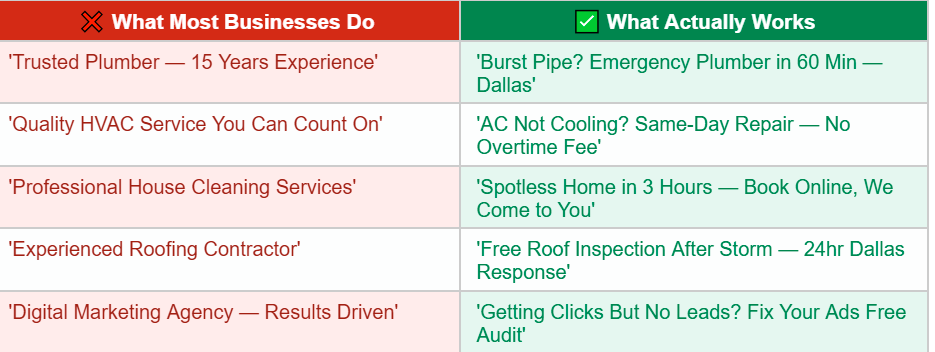
Lead with the customer's problem or desired outcome — not your credentials. On Meta, your visual creative is seen before your copy. If the image or video doesn't stop the scroll within 1–2 seconds, the headline never gets read. Test at least 3 different headlines per campaign and let data tell you which resonates. What you think will work and what actually works are often very different things.
You're Expecting Results Before the Algorithm Has Had Time to Learn
Both Google Ads and Meta Ads use machine learning to optimize your campaign over time. They learn which users convert, at what times of day, on which devices, from which locations. This learning process requires data — and data takes time to accumulate. Most campaigns need 4–6 weeks before the algorithm is truly optimized. The businesses that shut campaigns down after 10 days claiming 'it doesn't work' never reach that phase. They pay for the learning period and leave before the returns arrive.
A dental practice launched Google Ads for teeth whitening services. After 12 days they had spent $380 with only two inquiries. They paused the campaign. What they didn't know: both inquiries had come in the last three days — the algorithm had just started to find the right audience. A month later, a competitor launched the same campaign, let it run for 6 weeks, and was booking 8–12 new whitening appointments per month at $45 per lead.
Commit to a minimum 60-day testing window before evaluating a campaign's potential. Set expectations clearly: month one is data collection, month two is optimization, month three is when profitability typically appears. If results are genuinely terrible after 60 days with sufficient budget, audit the fundamentals — targeting, landing page, tracking, copy — rather than assuming the channel doesn't work.
The businesses generating consistent, predictable leads from paid advertising are not using secret tools or spending ten times more than you. They have five things in place simultaneously:
Tight, intent-driven targeting — phrase and exact match on Google with a maintained negative keyword list. Custom and lookalike audiences on Meta built from real customer data.
A landing page built to convert — one message, one CTA, fast on mobile, with proof elements (reviews, credentials, before/after) above the fold.
Verified conversion tracking — every call and form submission tracked back to the specific keyword, ad, and campaign that generated it.
Ad copy that leads with the customer's problem — headlines that make someone stop scrolling because they feel directly understood.
Consistent weekly optimization — someone reviewing data every week, cutting waste, testing new creative, and making incremental improvements that compound over time.
When these five elements work together, paid advertising becomes something genuinely powerful: a system that generates leads at a known, consistent cost — and that you can scale up as your business grows.
The clients at AheadTech360 who see the strongest results aren't the ones with the biggest budgets. They're the ones who trusted the process — who let the campaign gather data in month one, optimized aggressively in month two, and by month three had a lead machine running quietly in the background while they focused on delivering great work for their customers.
Paid ads are not a lottery. They're not luck. And they're not something that only works for big businesses with massive budgets.
They're a system. And like any system, they produce poor results when something in the system is broken — and excellent results when everything is working correctly together.
If your ads aren't working right now, one or more of five specific things is almost certainly the cause: wrong audience, weak landing page, broken tracking, generic ad copy, or not enough patience for the algorithm to learn.
None of those are unfixable. Most can be addressed within a week with the right diagnosis. And once they're fixed, the same budget that was producing nothing can start generating a pipeline of leads that grows your business month after month.
The platform isn't the problem. The setup is. And every setup can be fixed.