We helped 75+ brands generate $1.56M+ in revenue. Average ROI: 240% in Year 1
When it's time to build a website for your small business, WordPress and Shopify will come up in almost every conversation. They're the two most widely used website platforms in the world — and they look, on the surface, like they do the same thing.
They don't.
WordPress and Shopify are built for fundamentally different purposes, serve different types of businesses best, and have very different implications for your cost, your ongoing workload, and how well your site performs on Google. Choosing the wrong one — and many businesses do — means either paying to rebuild sooner than expected or limiting your growth because your platform can't handle where your business is going.
This guide gives you a plain-English breakdown of both platforms across every dimension that matters — so you can make an informed decision before you talk to any developer.
At AheadTech360, we build on both WordPress and Shopify — so we have no financial reason to push you toward either one. What we've found after building on both: most businesses choose their platform for the wrong reason (usually because someone they know uses it), end up limited by that choice within 18 months, and pay significantly more to migrate than they would have paid to choose correctly the first time. This guide is designed to help you avoid that.
WordPress is an open-source content management system (CMS) — a flexible, highly customizable platform that started as a blogging tool and evolved into the foundation for 43% of all websites on the internet. You install it on your own hosting, choose a theme, add plugins for functionality, and have complete control over every aspect of your site. That flexibility is its biggest strength and its biggest complexity.
Shopify is a fully hosted, all-in-one ecommerce platform — purpose-built for selling products online. It handles hosting, security, payment processing, inventory management, and shipping integrations in a single monthly subscription. You don't manage servers, install updates, or worry about security patches. You focus entirely on selling. That simplicity is its biggest strength and its biggest limitation.
The shortcut answer: if your business primarily sells services, content, or information — WordPress is almost always the right choice. If your business primarily sells physical or digital products — Shopify is almost always the right choice. Everything else is nuance.
Here is a direct side-by-side breakdown across every dimension that matters for a small business making this decision:
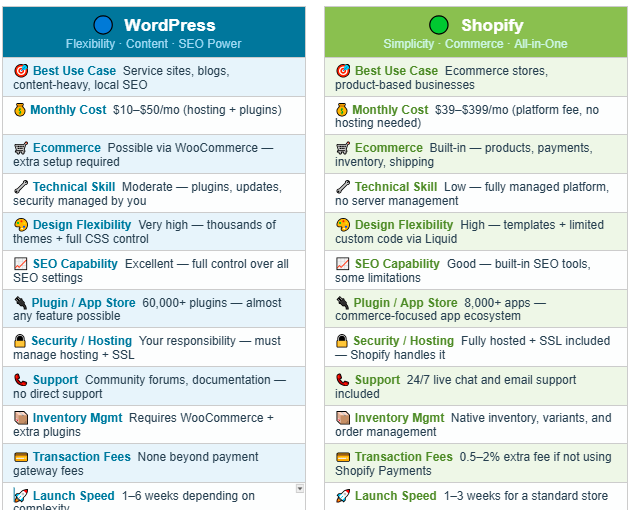
The most important observation from this comparison: for ecommerce, Shopify wins on simplicity and built-in functionality. For content, SEO, and service businesses, WordPress wins on flexibility and cost. The question is which set of trade-offs fits your business model.
WordPress — When It's the Right Choice
WordPress is the right foundation for your website when content, visibility, and flexibility are more important than built-in commerce functionality. Here's when WordPress consistently outperforms Shopify:
Plumbers, lawyers, dentists, cleaners, contractors, consultants, accountants — any business where the primary goal of the website is to generate leads through phone calls or contact form submissions. WordPress with a quality theme and SEO plugins like Rank Math or Yoast gives you complete control over every on-page SEO element — title tags, meta descriptions, schema markup, internal linking — which matters enormously for local search rankings.
WordPress was built for content publishing. If your business strategy involves generating organic traffic through blog content, educational articles, or resource pages — WordPress's content management capabilities are unmatched. Creating, organizing, and optimizing large volumes of content is significantly easier on WordPress than on Shopify, which treats blog functionality as secondary to the shopping experience.
With 60,000+ plugins available, WordPress can be extended to do almost anything: membership sites, online booking systems, course platforms, client portals, appointment scheduling, multi-language sites, and complex directory structures. If your website needs to do something unusual or highly specific to your business workflow, WordPress almost certainly has a plugin for it. Shopify's app store is more restricted to commerce-related functionality.
WordPress's biggest hidden cost is ongoing maintenance. Because WordPress is self-hosted and open-source, you're responsible for keeping your PHP version, WordPress core, themes, and plugins updated. Outdated plugins are the #1 cause of WordPress security breaches. Budget $50–$150/month for managed WordPress hosting with automatic updates and security monitoring — or factor in the time to manage this yourself. A WordPress site that hasn't been updated in 6 months is a security liability.
Shopify is the right foundation when selling products online is the primary purpose of your website and you want a platform that handles the technical complexity of ecommerce so you can focus on running your business.
If you sell physical products — clothing, home goods, specialty food, hardware, beauty products, sporting equipment — Shopify's built-in inventory management, product variants, shipping integrations, and payment processing make it dramatically easier to run than a WordPress + WooCommerce setup. Adding a new product, processing an order, generating a shipping label, and issuing a refund are all handled within a single, clean interface designed specifically for these tasks.
Shopify is fully hosted — Shopify manages the servers, security updates, SSL certificates, CDN, and uptime monitoring. You never log into a server dashboard, never worry about PHP compatibility after an update, never deal with a hacked site because a plugin wasn't updated. For business owners who are not technically inclined and don't want to be, this managed simplicity has real value that justifies the higher monthly fee.
As an ecommerce business scales from 100 to 1,000 to 10,000 monthly orders, Shopify's infrastructure scales with it seamlessly. WooCommerce on WordPress can handle high volumes too — but it requires progressively more expensive hosting, more aggressive caching configurations, and more developer involvement to maintain performance under load. Shopify's architecture is built for scale without additional configuration.
One situation where we almost always recommend Shopify over WordPress at AheadTech360: a product-based business that wants to start selling online within 2–3 weeks with minimal technical involvement. WordPress + WooCommerce can achieve the same ecommerce functionality — but the setup is more complex, the ongoing maintenance is higher, and the time to launch is typically 2–4 weeks longer for the same quality of store. If speed to market and operational simplicity are priorities, Shopify is the right platform.
For business owners who want to evaluate both platforms on individual criteria, here's a direct head-to-head across the factors that matter most:
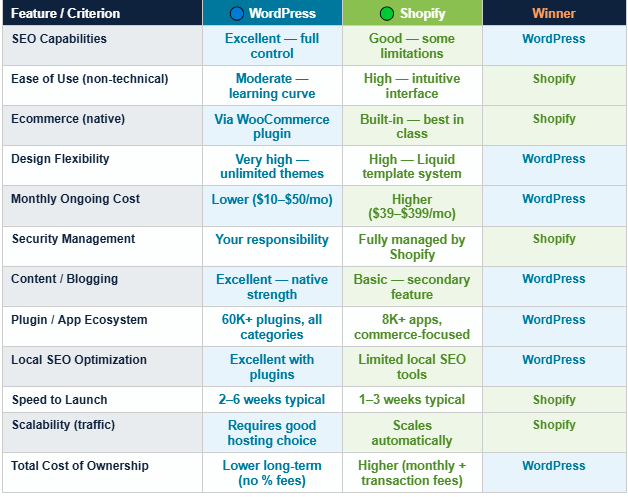
Neither WordPress nor Shopify is the objectively better platform — they're the right platform for different situations. WordPress wins when your website's primary job is to generate leads through search visibility, content, and credibility. Shopify wins when your website's primary job is to sell products online with minimal operational complexity. If you're still not sure after reading this guide, the deciding question is simple: Does your business make most of its money from services and relationships — or from selling products? The answer almost always points you to the right platform.
A question we hear frequently at AheadTech360: 'Can I start on WordPress and add a Shopify store later?' Yes — and this hybrid approach actually works well for businesses that are primarily service-based but sell a small line of physical products. WordPress handles the service pages, blog, and local SEO. A Shopify Buy Button embedded on relevant pages handles product transactions. You get the SEO power of WordPress and the commerce simplicity of Shopify without maintaining a full Shopify store.
The Bottom Line
WordPress and Shopify are both excellent platforms — for the right business. The decision is not about which is more popular or which a friend recommended. It's about which platform's strengths align with what your website needs to do.
If you generate revenue through services, relationships, and local search visibility — WordPress gives you the SEO control, content flexibility, and customization capability to build a website that performs as a genuine business asset. If you generate revenue by selling products online and want a platform that handles all the operational complexity of ecommerce without technical overhead — Shopify delivers simplicity, reliability, and commerce tools that WordPress cannot match out of the box.
Choose based on your business model, not platform popularity. The best website platform is the one that helps your specific business acquire more customers — everything else is secondary.