We helped 75+ brands generate $1.56M+ in revenue. Average ROI: 240% in Year 1
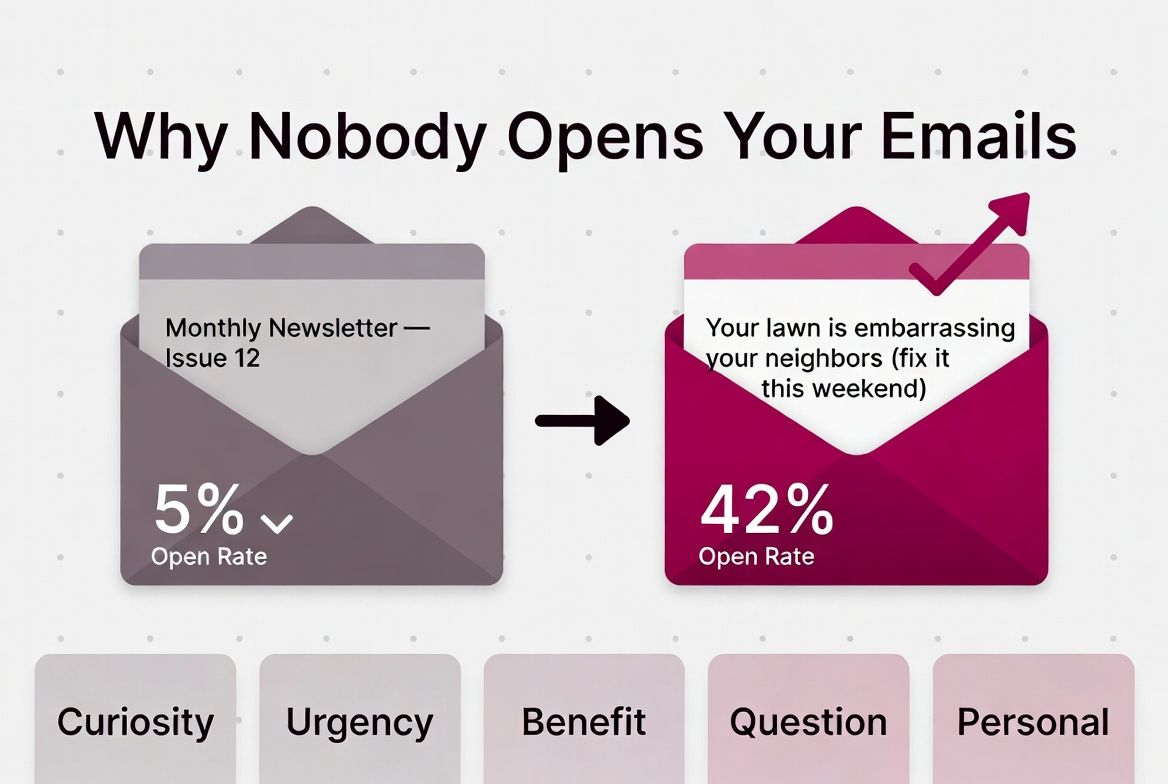
Most marketing emails fail at the first hurdle: nobody opens them.
They sit unopened in an inbox alongside hundreds of other emails, get glanced at for 0.3 seconds, and either deleted or left to age until the subscriber eventually unsubscribes or marks the sender as spam.
This doesn't happen because email marketing doesn't work. It happens because most small businesses write emails that are about themselves rather than about their reader — and use subject lines that inspire the same enthusiasm as a utility bill.
Writing email campaigns that actually convert is a learnable skill. This guide breaks down exactly what separates emails that get opened, read, and acted on from the ones that don't — with real before/after examples, proven subject line formulas, and benchmark data to tell you how your campaigns are performing.
At AheadTech360, the first thing we audit when a client says 'our email marketing isn't working' is always their subject lines and opening lines. In 90% of cases, the content of the email itself is reasonable — but nobody is getting far enough to read it because the subject line gives them no reason to open it. Fixing these two elements alone typically improves open rates by 40–80% before any other changes are made.
Every marketing email has five components that work together to generate opens, reads, clicks, and conversions. Weakness in any one of them undermines the rest.
Subject Line — The headline that determines whether anyone opens the email at all. It's read in 2–3 seconds and competes against 50–200 other emails in the inbox. Everything else is irrelevant if the subject line fails.
Preview Text — The 40–90 characters that appear in the inbox view next to or below the subject line. Most businesses leave this blank or let it auto-populate with 'View this email in your browser' — a wasted opportunity to add a second hook.
Opening Line — The first sentence after the email opens. If the subject line gets them to open, the opening line keeps them reading. It should be short, direct, and immediately interesting.
Body Copy — The content that delivers the value, context, or story. Should be concise, scannable, and written in plain conversational language — not corporate marketing speak.
Call to Action (CTA) — One clear, specific instruction: what you want them to do next. Not 'click here' or 'learn more' — but 'Book your free consultation' or 'Claim your 20% discount before Friday.'
Here is exactly what the difference looks like across all five email elements — using a home cleaning business as the example:
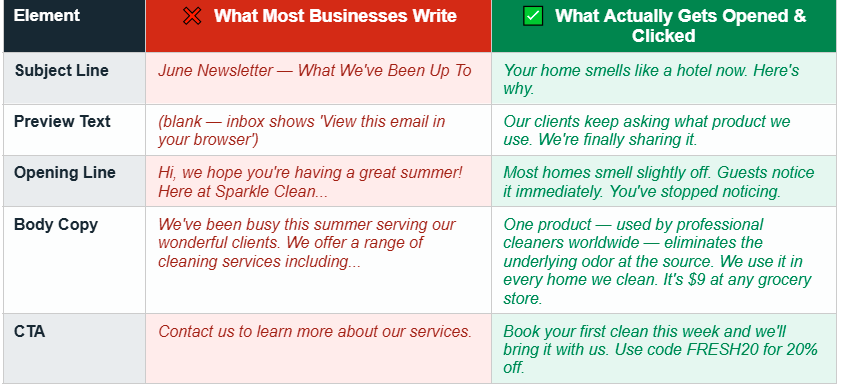
The difference is not the budget, the platform, or the email design. The difference is the email on the right speaks to a specific, relatable customer concern and makes reading feel worthwhile. Every line answers the reader's implicit question: 'Why should I keep reading this?'
You don't need to reinvent the wheel for every email. These five formulas reliably outperform generic subject lines across most industries. Use them as templates and fill in your specific offer, product, or situation:
The Curiosity Gap
📧 Example: The one thing we stopped doing that doubled our bookings
💡 Why it works: Creates an information gap the reader needs to close. The brain is wired to seek the missing piece — but the subject line must be specific enough to be credible, not clickbait.
The Direct Benefit
📧 Example: Get your lawn summer-ready in 45 minutes (no equipment needed)
💡 Why it works: States exactly what the reader will gain from opening. Specificity is key — '45 minutes' is more compelling than 'quickly.' Works best for how-to and tip emails
The Urgency / Scarcity Frame
📧 Example: Only 3 spots left this month — grab yours before Friday
💡 Why it works: Creates time pressure or limited availability. Only effective when genuine — fake urgency damages trust and unsubscribe rates spike. Use only when the scarcity is real
The Question
📧 Example: Are you making this mistake with your HVAC filter?
💡 Why it works: Asks a question the reader needs to answer about themselves. Highly effective when the question implies a potential problem or mistake — readers open to find out if they're affected
The Personal / First Name Hook
📧 Example: [First Name], your estimate is ready — here's what we found
💡 Why it works: Uses personalization or specificity to create the feeling of a 1-to-1 message. Works best for follow-up sequences, appointment reminders, and re-engagement campaigns where personal context exists
Knowing your numbers is the only way to improve them. Here are the 2026 industry average benchmarks for US small businesses across key email marketing metrics:
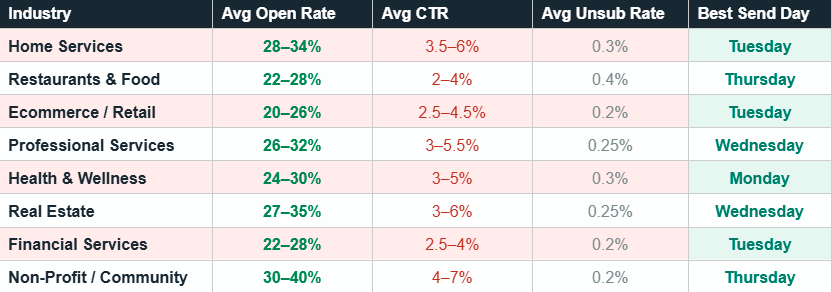
If your open rate is below 20% for two or more consecutive campaigns, your subject lines need work — or your list quality is poor (old contacts, purchased addresses, or inactive subscribers dragging down your average). If your CTR is below 1.5%, your email body or
CTA needs improvement. Use these benchmarks as diagnostic tools, not just performance comparisons.
The most damaging thing you can do to your email performance is send too frequently without providing value. The average unsubscribe rate doubles when businesses move from 2 emails/month to 8+ emails/month without increasing content quality. More frequency only works if every email is genuinely worth opening. If you're running out of valuable things to say at 4 emails/month, the right answer is 2 emails/month — not padding with filler content that trains subscribers to ignore you.
Rewrite your first sentence. Most marketing emails open with something about the business ('We're excited to share...', 'This month at [Company]...'). Your best first sentence starts with your reader's problem, desire, or situation — not with you. Try this test: read your opening sentence and ask 'Is this about me or about them?' If the answer is 'me' — rewrite it. This single change typically improves read-through rates by 25–40%.
Writing email campaigns that convert is not about fancy design or expensive tools. It's about understanding that every email is a competition for a few seconds of attention — and the businesses that win that competition consistently are the ones writing about their reader, not about themselves.
Start with the subject line. Make it specific, curious, or urgent — but always honest. Open with a sentence about your reader's problem or situation. Keep the body short and focused on one idea. End with one clear action. Test, measure, and improve.
The difference between a 15% open rate and a 35% open rate is not the platform, the design, or the send time. It's the words you choose — and whether they make your reader feel that opening was worth their time.