We helped 75+ brands generate $1.56M+ in revenue. Average ROI: 240% in Year 1
There are dozens of email marketing platforms available — and they all claim to be the best option for small businesses. Most of them have very similar core features. The real differences lie in price, ease of use, automation capabilities, ecommerce integration, and how well they scale as your list grows.
Choosing the wrong platform early on is an expensive mistake — not because the platforms themselves cost much, but because migrating your list, your templates, and your automation sequences to a new platform later is time-consuming, technically complex, and often results in temporary deliverability issues.
This guide reviews the 5 platforms that consistently perform best for small businesses — with honest assessments of what each one does well, where each one falls short, and a clear decision matrix to match the right platform to your specific situation.
At AheadTech360, we work across multiple email platforms depending on what our clients' businesses require. There is no single 'best' platform — there is the best platform for your specific list size, budget, technical comfort level, and whether you're primarily running a service business, an ecommerce store, or a content-driven brand. This guide gives you the framework to identify which of those describes you.
The world's most recognized email marketing platform — strong free tier, broad integrations
💰 Cost: Free up to 500 contacts / 1,000 emails per month. Essentials from $13/mo. Standard from $20/mo. Premium from $350/mo.
🎯 Best For: Small businesses just starting out who want the most widely-supported platform with the most third-party integrations and tutorials available.
🔧 Key Features: Drag-and-drop builder, basic automation, audience segmentation, A/B testing, landing pages, social media integration, analytics dashboard.
✅ Strengths: Most integrations of any platform. Largest knowledge base and community. Free tier is genuinely functional for very small lists. Widely recognized brand.
⚠️ Watch Out: Free tier became more limited in 2024 — automation locked to paid plans. Gets expensive quickly at Essentials/Standard tiers compared to competitors. UI has become complex over the years
The best free plan for small businesses — automation included at no cost
💰 Cost: Free up to 1,000 subscribers / 12,000 emails per month — automation included. Growing Business from $9/mo. Advanced from $19/mo.
🎯 Best For: Small businesses starting out who want a full-featured platform with automation on the free plan. Best value-to-cost ratio in the market for lists under 5,000 subscribers.
🔧 Key Features: Drag-and-drop builder, automation workflows, landing pages, pop-up forms, A/B testing, segmentation, website builder, sell digital products.
✅ Strengths: Best free plan of any major platform — includes automation at no cost. Extremely clean, intuitive interface. Fast to learn. Strong deliverability rates. Competitive pricing at all tiers.
⚠️ Watch Out: Fewer integrations than Mailchimp. Less sophisticated CRM capabilities. Not ideal for complex ecommerce automation or large enterprise use cases.
Built for creators and content businesses — powerful for audience monetization
💰 Cost: Free up to 10,000 subscribers (limited features). Creator from $25/mo. Creator Pro from $50/mo.
🎯 Best For: Content creators, bloggers, coaches, course sellers, and professional service providers who generate leads primarily through content and need sophisticated subscriber tagging and segmentation.
🔧 Key Features: Visual automation builder, subscriber tagging, broadcast emails, landing pages, paid newsletter support, commerce integrations, subscriber scoring.
✅ Strengths: Industry-best visual automation builder. Subscriber tagging is the most flexible of any platform — perfect for segmenting by interest or behaviour. Clean, simple interface. Strong creator community.
⚠️ Watch Out: More expensive than MailerLite for equivalent subscriber counts. Less suited for traditional ecommerce (limited product promotion features). Overkill for very simple campaigns.
The most powerful automation platform for growing businesses
💰 Cost: Lite from $29/mo (up to 1,000 contacts). Plus from $49/mo. Professional from $149/mo. No free plan.
🎯 Best For: Growing small businesses and agencies that need advanced automation, CRM integration, and sophisticated audience segmentation. Not recommended as a starting platform — better as a step-up once basic email is established.
🔧 Key Features: Advanced automation workflows, built-in CRM, lead scoring, predictive sending, conditional content, sales pipeline, site tracking, SMS marketing.
✅ Strengths: Most powerful automation capabilities of any platform at this price point. Built-in CRM is genuinely useful. Deep personalization and segmentation. Best choice for B2B businesses needing complex nurture sequences.
⚠️ Watch Out: Steeper learning curve — not beginner-friendly. No free plan. More expensive than simpler alternatives. Overkill for businesses sending simple newsletters or basic promotional emails
Free CRM-native email — ideal if you're already in the HubSpot ecosystem
💰 Cost: Free (up to 2,000 emails/month, HubSpot branding). Starter from $20/mo. Professional from $890/mo.
🎯 Best For: Businesses already using HubSpot CRM who want email marketing natively integrated with their contact management and sales pipeline — without importing/exporting contacts between tools.
🔧 Key Features: Email marketing, CRM integration, contact segmentation based on CRM data, automation workflows, sales pipeline visibility, reporting dashboard, landing pages.
✅ Strengths: Best CRM integration of any platform — email behavior feeds directly into your sales pipeline. Free tier is functional for basics. All contact history in one place. Professional tier includes full marketing automation.
⚠️ Watch Out: Professional tier pricing ($890/mo) is prohibitive for most small businesses. HubSpot branding on free tier. Email features are secondary to CRM — not the strongest standalone email platform
⭐⭐⭐ = Excellent • ⭐⭐ = Good • ⭐ = Basic / Limited
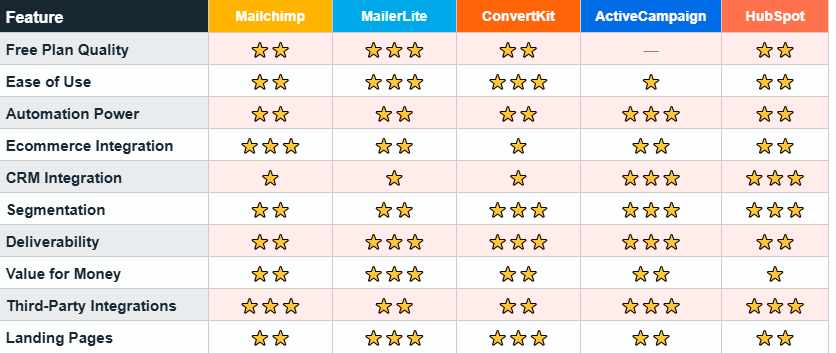
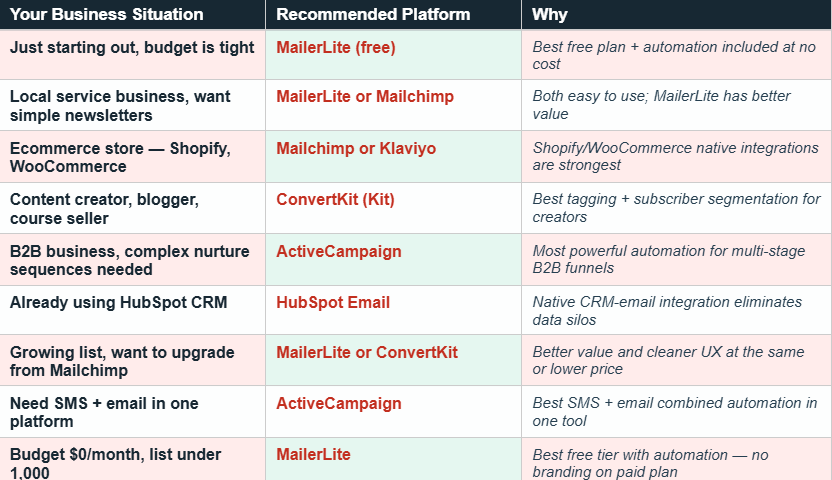
The most expensive email marketing mistake is choosing a platform based on brand recognition alone. Mailchimp is the most widely known platform — but it is no longer the best value for most small businesses. MailerLite offers equivalent or better features for significantly less money, with a more generous free plan. If you're currently paying for Mailchimp's Essentials or Standard plan and not using advanced ecommerce features, you're almost certainly overpaying by $10–$50/month for the same functionality available elsewhere
If you're starting from scratch with a small list (under 1,000 subscribers): start with MailerLite's free plan. It includes automation, landing pages, and pop-up forms at no cost, and upgrades to paid plans are among the cheapest in the market. If you're running a Shopify ecommerce store: use Klaviyo — its native Shopify integration and revenue-tracking capabilities are unmatched. If you need a CRM and email in one place: start with HubSpot's free CRM + free email tier and upgrade when your needs outgrow it.
The best email marketing tool for your small business is the one you'll actually use consistently — at a price that makes the ROI calculation easy, with enough features to grow into as your list and campaigns become more sophisticated.
For most small businesses starting or upgrading today: MailerLite for its unmatched free plan and value; Klaviyo for ecommerce; ActiveCampaign for B2B businesses needing sophisticated automation; HubSpot if you're already in that ecosystem.
Don't let platform analysis become an excuse for delay. The best email platform is the one you're actually sending emails from. Start, measure, and upgrade as your needs grow.