We helped 75+ brands generate $1.56M+ in revenue. Average ROI: 240% in Year 1
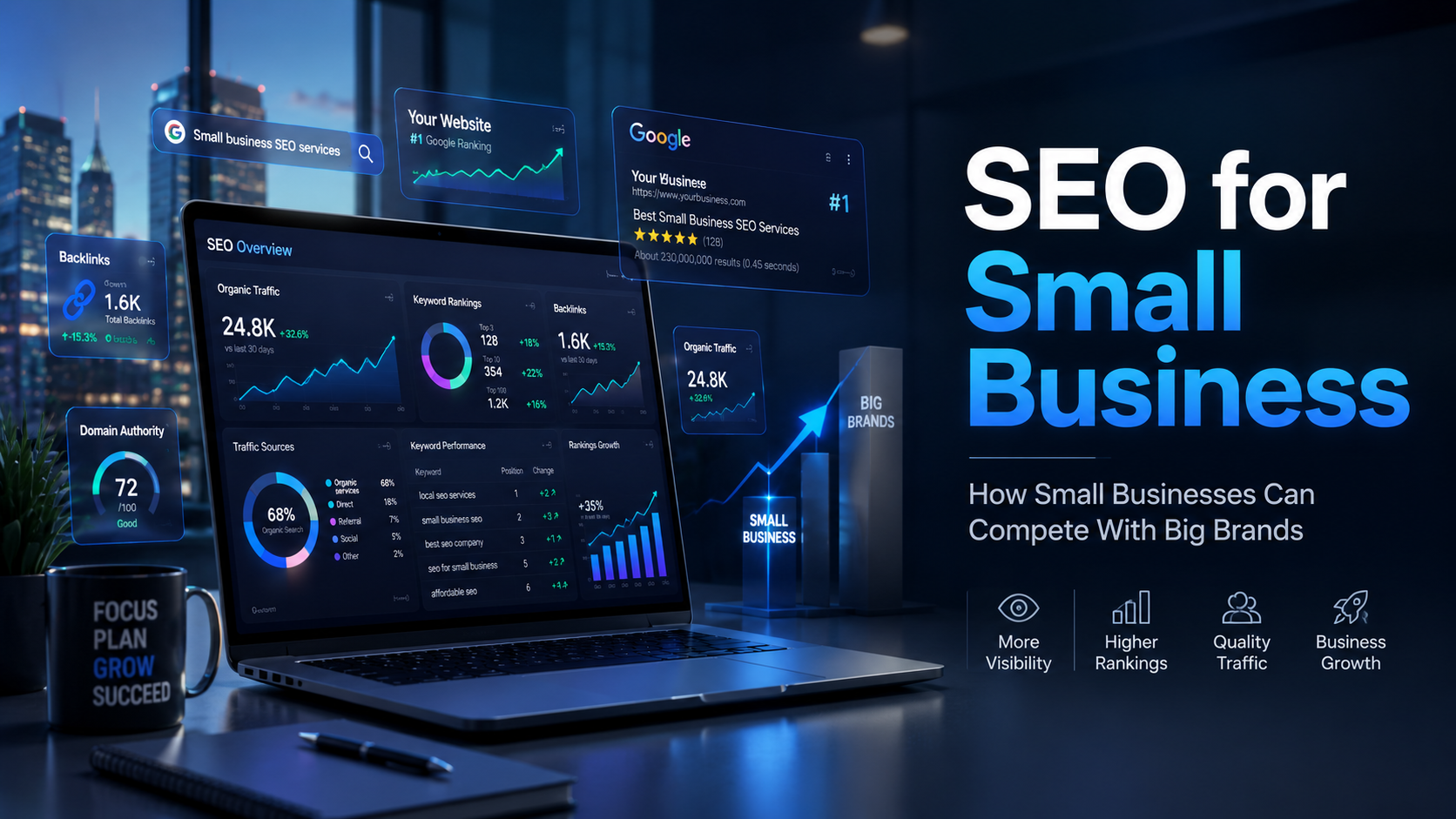
Small business owners often assume they cannot compete with large brands online. Bigger companies have larger marketing budgets, dedicated marketing teams, and years of brand recognition. At first glance, it may seem impossible for a small business website to outrank established competitors in Google search results.
Over the years, we've worked with businesses in competitive industries that had limited marketing budgets but still achieved significant growth through strategic search engine optimization. The reality is that Google does not rank websites based on company size. It ranks websites that best satisfy search intent, provide helpful information, and deliver a strong user experience.
This is why SEO for small business remains one of the most cost-effective digital marketing investments available today.
Many large brands focus on broad keywords because they want to attract the largest possible audience. While this approach works for them, it often leaves opportunities for smaller businesses.
Small businesses can focus on:
Specific services
Local markets
Niche industries
Customer pain points
High-intent search queries
Search engines increasingly prioritize relevance over brand size. If your content provides a better answer to a user's question, you can often outrank larger competitors for targeted searches.
We've consistently found that businesses focusing on customer intent rather than search volume alone often generate higher-quality leads. Lower-volume keywords frequently attract visitors who are much closer to making a purchase decision.
SEO for small business is the process of improving a website's visibility in organic search results to attract potential customers without relying entirely on paid advertising.
A successful small business SEO strategy typically includes:
Keyword research
Content creation
On-page optimization
Technical SEO
Local SEO
Link building
User experience improvements
The goal is simple: help your ideal customers find your business when they search for products or services online.
One of the biggest mistakes small businesses make is targeting only high-volume keywords.
Traffic alone does not generate revenue.
The most successful SEO campaigns focus on keywords that indicate buying intent.
Examples include:
SEO for small business
Affordable SEO services for small businesses
Local SEO services
SEO company for small business
Best SEO company for small business
These searches often attract users who are actively looking for solutions rather than simply gathering information
When evaluating keyword opportunities, we often prioritize relevance and conversion potential over search volume. A keyword generating 100 qualified visitors can outperform one generating 1,000 unqualified visitors.
Search engines have evolved significantly.
Google AI Overviews, AI-powered search experiences, and conversational search platforms now prioritize content that directly answers user questions.
Instead of writing content solely for rankings, focus on helping customers.
Ask yourself:
What questions do prospects ask before buying?
What concerns prevent them from making a decision?
What information would make their purchasing process easier?
Every article should aim to solve a specific problem.
For example, if someone searches for SEO for small business, they may want answers to questions such as:
How much does SEO cost?
How long does SEO take?
Can a small business compete with larger companies?
What SEO strategies work best for local businesses?
The more effectively your content answers these questions, the greater your chances of earning visibility in both traditional search results and AI-generated responses.
One of the most effective ways to demonstrate SEO success is through real-world implementation.
At AheadTech360, we worked with EzDTF Maker, a company serving customers across multiple locations within the DTF printing industry.
The Challenge
Although the company offered services across various regions, its website primarily ranked for broad industry terms.
The website lacked strong visibility for location-based searches, which meant potential customers searching for services in specific cities were often finding competitors instead.
After conducting a detailed SEO audit and keyword research process, we developed a location-focused SEO strategy.
This included:
Creating city-specific landing pages
Conducting local keyword research
Building unique content for each location
Optimizing on-page SEO elements
Improving internal linking structure
Strengthening site architecture
Rather than creating duplicate pages, each location page was designed to address the needs of customers in that specific market.
Over time, the website gained visibility across multiple target locations.
The strategy helped:
Increase local keyword rankings
Improve organic visibility
Expand reach into additional markets
Generate more qualified traffic
Strengthen brand awareness across multiple cities
Many businesses focus only on broad keywords while overlooking location-based opportunities. For businesses serving multiple regions, city-specific SEO pages can create substantial growth opportunities.
For many small businesses, local SEO provides the fastest path to generating qualified leads.
When users search for services near them, search engines prioritize:
Relevance
Distance
Trust signals
This creates opportunities for smaller businesses to compete effectively.
Important local SEO activities include:
Optimizing Google Business Profile
Collecting customer reviews
Building local citations
Creating location pages
Maintaining consistent business information
Businesses that invest in local SEO often see stronger lead quality because they attract customers actively searching within their service area.
Many business owners eventually ask whether they should manage SEO internally or hire professionals.
The answer depends on:
Available time
Internal expertise
Growth goals
Market competition
Working with experienced SEO companies for small business can often accelerate results by providing access to proven strategies, technical expertise, and ongoing optimization.
When evaluating providers, look for:
Proven experience
Transparent communication
Documented case studies
Long-term strategy
Ethical SEO practices
The best SEO company for small business is not necessarily the cheapest option. The right partner focuses on sustainable growth rather than short-term ranking spikes.
Businesses that consistently invest in content, optimization, and technical improvements typically achieve the strongest long-term ROI from SEO.
Final Thoughts
Small businesses do not need massive marketing budgets to compete online. They need a focused strategy, consistent execution, and a commitment to helping customers find valuable information.
SEO for small business remains one of the most effective ways to increase visibility, attract qualified traffic, and generate sustainable growth. While larger brands may have bigger budgets, smaller businesses often have the advantage of agility, specialization, and a deeper understanding of customer needs.
At AheadTech360, we've seen firsthand how businesses can improve rankings, expand market visibility, and generate qualified leads through strategic SEO. The businesses that succeed online are rarely the biggest—they are usually the ones that consistently provide the most value to their audience.