We helped 75+ brands generate $1.56M+ in revenue. Average ROI: 240% in Year 1
Think about the last time you needed something quickly.
Maybe it was a dentist taking new patients. A reliable electrician. A good pizza place open on Sunday night.
What did you do?
You grabbed your phone and searched.
"dentist near me"
"best electrician in [city]"
"pizza delivery open now"
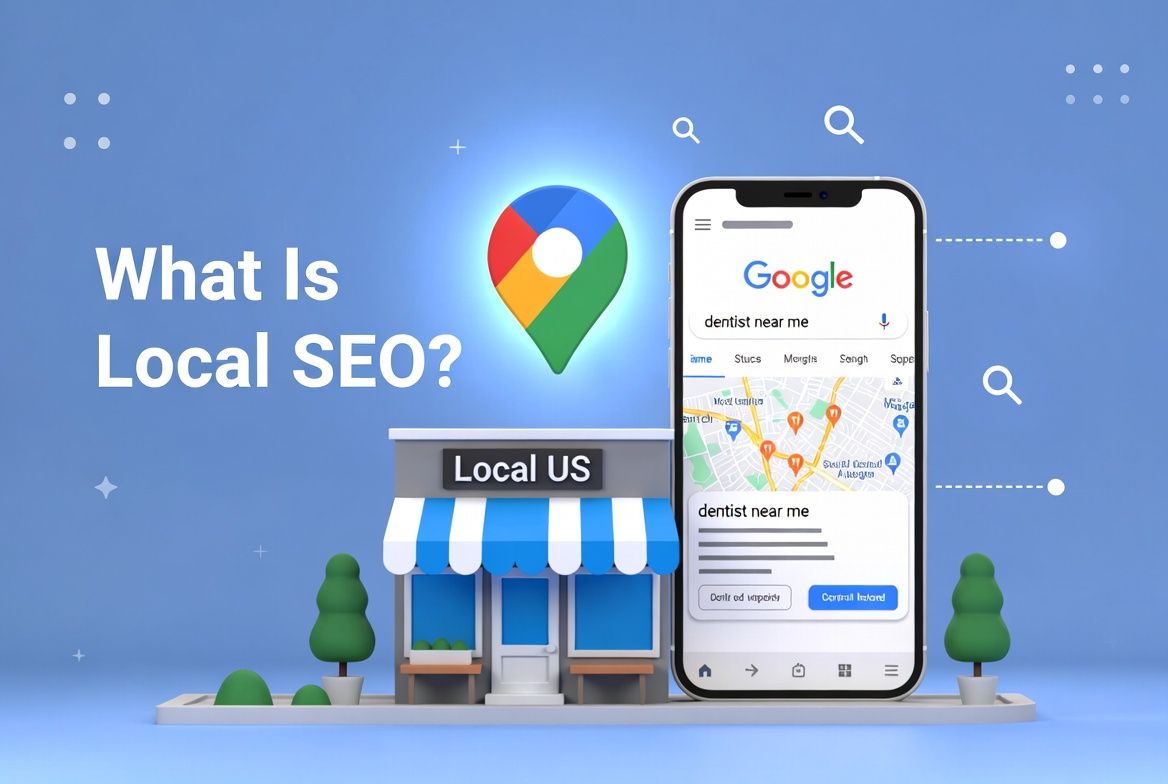
And within seconds, Google showed you a map with three businesses — their name, star rating, hours, distance, and a button to call them directly.
That map? That's local SEO at work.
If your business isn't showing up there, someone else is getting those customers. The person who just searched never even knew you existed — and they already called your competitor.
This guide explains exactly what local SEO is, why it matters more than ever in 2026, and what you need to do to start showing up where your customers are already looking.

What Is Local SEO
Local SEO (Local Search Engine Optimization) is the process of making your business visible when people nearby search for what you offer on Google.
It's different from regular SEO, which tries to rank nationally or globally for broad topics. Local SEO is specifically about showing up in your city, your neighborhood, your zip code — for searches that have local intent behind them.
When someone searches 'coffee shop near me' or 'best HVAC company in Dallas' — local SEO determines which three businesses appear in that map pack at the top of the results. Those three spots represent the most valuable real estate in local digital marketing. And here's what most small business owners don't realize:
The top local SEO spots don't go to the biggest companies or the businesses with the largest advertising budgets. They go to the businesses with the most optimized local presence — regardless of size. A one-person plumbing operation can outrank a national chain. A single-location bakery can beat a franchise. That's not a fluke — it's how Google's local algorithm is designed. Proximity, relevance, and reputation matter far more than company size or ad spend.
Both are about getting found on Google — but they target very different audiences with very different strategies. Here's how they compare:
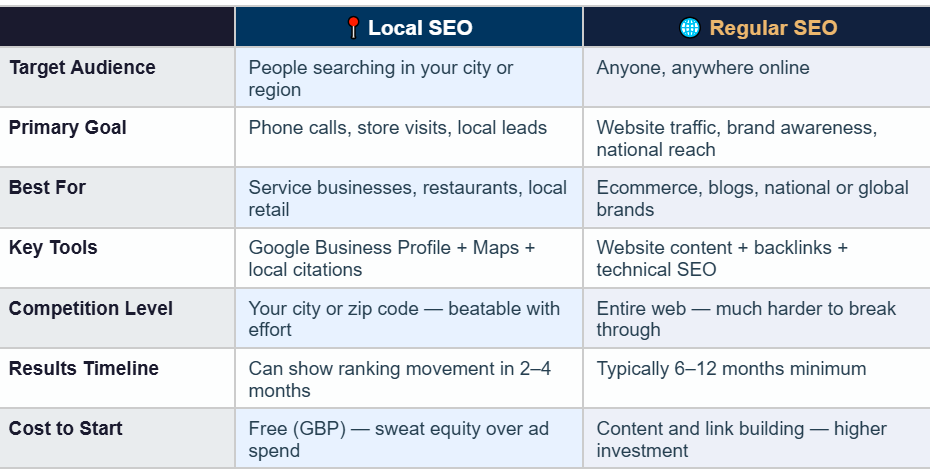
If you run a business that serves customers in a specific geographic area — a plumber, a dentist, a restaurant, a cleaning service, a law firm — local SEO is your single most powerful organic marketing tool. It directly connects you to buyers who are actively searching and ready to act.
One of the most common mistakes we see at AheadTech360 is small businesses investing heavily in content and backlinks (regular SEO) before their local SEO foundation is even in place. For a local service business, getting your Google Business Profile fully optimized and building NAP consistency across directories will generate more calls, faster, than almost any other SEO activity. Local first — always.
Local search behaviour has changed significantly in the past two years — and the change is accelerating. People are no longer just typing queries into Google. They're asking AI assistants, using voice search, and getting answers from Google's AI Overview before they ever see a list of links.
This shift changes what 'showing up' means in 2026:
Google Maps & the 3-Pack — Still the most clicked real estate in local search. The three businesses that appear in the map pack get the vast majority of local search clicks. A fully optimized Google Business Profile is the entry ticket.
Google AI Overview — Google's AI now answers many local queries directly at the top of the page, often pulling from your GBP, your website's structured content, and your reviews. Businesses with complete, accurate, review-rich profiles are cited first.
Voice Search — Searches like 'Hey Google, find me a plumber near me' go directly to local results. Voice queries tend to be longer and more conversational — which means FAQ-style content and complete GBP profiles win here.
ChatGPT & AI Tools — When someone asks ChatGPT to recommend a local business, it pulls from public web data — primarily your GBP, your website, and third-party review sites. Local businesses with strong online presence and consistent information across the web get recommended more frequently.
Local SEO in 2026 is not just about Google Search anymore. It's about being the business that gets mentioned, recommended, and cited everywhere people look for local services — including AI tools that millions of consumers now use daily. If your online presence is incomplete, inconsistent, or thin, you're invisible across all of these channels simultaneously.
Local SEO is not one single thing. It's four interconnected areas that work together. When all four are optimized, the compounding effect on your local visibility is significant. Neglect any one of them and the others underperform.
Your most important free tool — don't leave it half-finished
Your Google Business Profile (GBP) is the single most impactful tool in local SEO. It controls what appears on Google Maps and in the local results panel when someone searches for a business like yours. A fully optimized GBP includes your business name, primary and secondary categories, address, phone number, website, business hours, service list, product photos, team photos, and owner responses to every review.
Businesses with complete, active GBP profiles consistently outrank those with incomplete ones — even when the incomplete business has a better website or more reviews. Completeness signals to Google that you are a real, active, trustworthy business.
If you have not yet claimed and fully completed your GBP — this is your single highest-priority action. It is free, it is foundational, and it produces results faster than almost anything else in local SEO.
Tell Google where you are and exactly what you do
Your website needs to clearly communicate your location and your services to Google. That means using location-specific language throughout your pages — not keyword-stuffing, but naturally including your city, service area, and specific services in your headlines, page content, title tags, and meta descriptions.
If you serve multiple cities, create a dedicated service-area page for each one. 'We serve homeowners across Austin, Round Rock, and Cedar Park' — with a dedicated page for each city — tells Google exactly where to rank you, for which services, in which locations.
A website with no location context at all is one of the most common and most costly local SEO mistakes. Generic service descriptions with no city mentions give Google nothing to work with.
Your business information must be identical everywhere it appears
A citation is any mention of your business Name, Address, and Phone number (NAP) on an external website — Yelp, Yellow Pages, Angi, BBB, Apple Maps, Bing Places, industry-specific directories, and local Chamber of Commerce listings.
Consistency matters more than quantity. If your phone number appears as (512) 555-0100 on Google and 512-555-0100 on Yelp and +1 512 555 0100 on Yellow Pages — Google cannot confirm which one is correct. These inconsistencies create doubt, and doubt hurts rankings.
Audit your existing citations first. Fix any inconsistencies. Then build new listings on the key directories — always using exactly the same NAP format across every platform.
The ranking signal you cannot fake — and cannot ignore
Reviews are one of the strongest local ranking signals Google uses. More reviews — especially recent, positive, keyword-rich reviews — directly improve your visibility in the local 3-Pack. The word 'keyword-rich' matters here: a review that says 'best emergency plumber in Phoenix' is more valuable for local rankings than one that says 'great service.'
But reviews aren't just about ranking. They are the first thing a potential customer reads before deciding whether to call you or your competitor. A business with 47 reviews at 4.8 stars will consistently outperform a business with 8 reviews at 5.0 stars — in both rankings and customer trust.
Respond to every review — positive and negative. Responding shows Google and potential customers that you are an active, attentive business owner. A thoughtful response to a negative review is one of the strongest trust signals a local business can display publicly.
When someone types 'near me' into Google, they are not browsing. They are not comparing options casually. They need something, they need it soon, and they are going to call whoever shows up first.
These searches represent the highest-intent traffic available to any local business. The person searching is not in the research phase — they are in the decision phase. Their credit card is accessible. Their phone is already in their hand. The only question is which business they're going to call.
Every day your business doesn't appear in those results is a day you're handing those customers to your competitor — for free.
At AheadTech360, we track 'near me' keyword performance as one of our core local SEO KPIs for every client. When a new client comes to us with zero local visibility, the first wins almost always come from 'near me' and '[service] in [city]' type searches — because these keywords have the clearest commercial intent and the most direct path from search to phone call. Getting ranked for these terms is what generates the first measurable business impact from SEO.
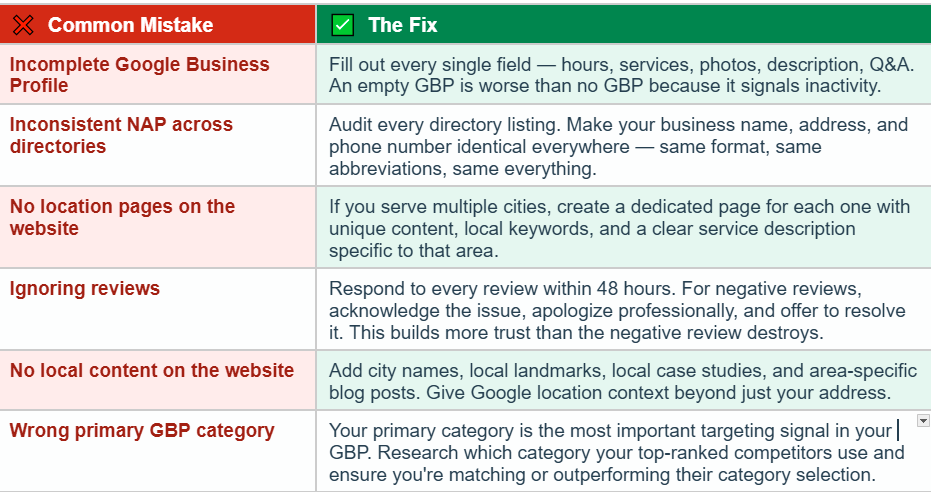
Most small businesses struggling with local visibility are making at least one of these mistakes right now. Each one is fixable — but only if you know it exists:
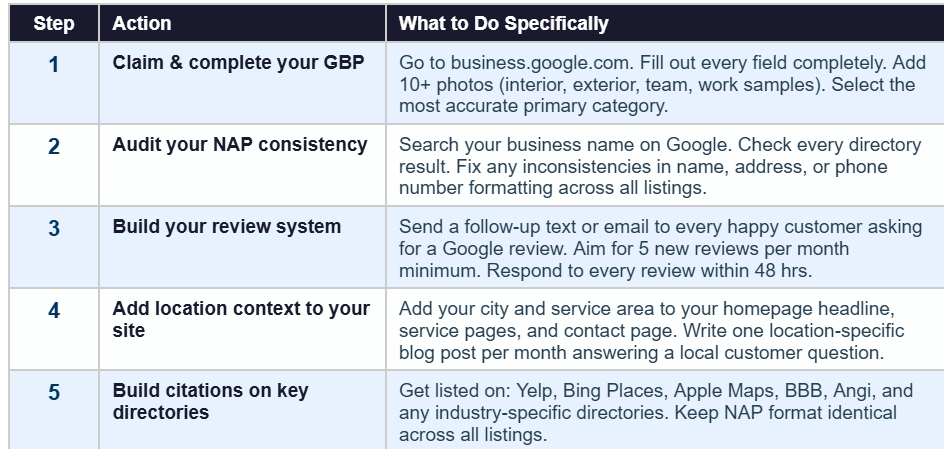
You do not need a large budget or an agency to start. These five steps, done in order, will move your local rankings faster than almost anything else you can do — and most of them are free:
Local SEO is not complicated. But it is consistent, intentional work — and it compounds over time in a way that paid advertising cannot replicate.
The businesses dominating Google Maps in your city didn't get there by accident. They built their presence step by step — optimizing their profile completely, earning reviews systematically, creating location-specific content regularly, and showing up consistently over months. Their competitors assumed it was out of reach. It wasn't.
You don't need to outspend anyone. You need to out-optimize them. Your customers are searching for you right now — the only question is whether you're showing up when they do.
Show up. Be consistent. Let Google do the rest.